by Adam Hartung | Nov 18, 2012 | Current Affairs, Defend & Extend, Food and Drink, In the Whirlpool, Leadership
Hostess Brands filed for liquidation this week. Management blamed its workforce for the failure. That is straightforward scapegoating.
In 1978 Dan White killed San Francisco's mayor George Moscone and city supervisor Harvey Milk. The press labeled his defense the "Twinkie Defense" because he claimed eating sugary junk food – like Twinkies – caused diminished capacity. Amazingly the jury bought it, and convicted him of manslaughter instead of murder saying he really wasn't responsible for his own actions. An outraged city rioted.
Nobody is rioting, but management's claim that unions caused Hostess failure is just as outrageous.
Founded in 1930 as Interstate Bakeries Co. (IBC) the company did fine for years. But changing consumer tastes, including nutrition desires, changed how much Wonder Bread, Twinkies, HoHos and Honey Buns people would buy — and most especially affected the price – which was wholly unable to keep up with inflation. This trend was clear in the early 1980s, as prices were stagnant and margins kept declining due to higher costs for grain and petroleum to fuel the country's largest truck fleet delivering daily baked goods to grocers.
IBC kept focusing on operating improvements and better fleet optimization to control rising costs, but the company was unwilling to do anything about the product line. To keep funding lower margins the company added debt, piling on $450M by 2004 when forced to file bankruptcy due to its inability to pay bills. For 5 years financial engineers from consultancies and investment banks worked to find a way out of bankruptcy, and settled on adding even MORE debt, so that – perversely – in 2009 the renamed Hostess had $670M of debt – at least 2/3 the total asset value!
Since then, still trying to sell the same products, margins continued declining. Hostess lost a combined $250M over the last 3 years.
The obvious problem is leadership kept trying to sell the same products, using roughly the same business model, long, long, long after the products had become irrelevant. "Demand was never an issue" a company spokesman said. Yes, people bought Twinkies but NOT at a price which would cover costs (including debt service) and return a profit.
In a last, desperate effort to keep the outdated model alive management decided the answer was another bankruptcy filing, and to take draconian cuts to wages and benefits. This is tanatamount to management saying to those who sell wheat they expect to buy flour at 2/3 the market price – or to petroleum companies they expect to buy gasoline for $2.25/gallon. Labor, like other suppliers, has a "market rate." That management was unable to run a company which could pay the market rate for its labor is not the fault of the union.
By constantly trying to defend and extend its old business, leadership at Hostess killed the company. But not realizing changing trends in foods made their products irrelevant – if not obsolete – and not changing Hostess leaders allowed margins to disintegrate. Rather than developing new products which would be more marketable, priced for higher margin and provide growth that covered all costs Hostess leadership kept trying to financial engineer a solution to make their horse and buggy competitive with automobiles.
And when they failed, management decided to scapegoat someone else. Maybe eating too many Twinkies made the do it. It's a Wonder the Ding Dongs running the company kept this Honey Bun alive by convincing HoHos to loan it money! Blaming the unions is simply an inability of management to take responsibility for a complete failure to understand the marketplace, trends and the absolute requirement for new products.
We see this Twinkie Defense of businesses everywhere. Sears has 23 consecutive quarters of declining same-store sales – but leadership blames everyone but themselves for not recognizing the shifting retail market and adjusting effectively. McDonald's returns to declining sales – a situation they were in 9 years ago – as the long-term trend to healthier eating in more stylish locations progresses; but the blame is not on management for missing the trend while constantly working to defend and extend the old business with actions like taking a slice of cheese off the 99cent burger. Tribune completey misses the shift to on-line news as it tries to defend & extend its print business, but leadership, before and afater Mr. Zell invested, refuses to say they simply missed the trend and let competitors make Tribune obsolete and unable to cover costs.
Businesses can adapt to trends. It is possible to stop the never-ending chase for lower costs and better efficiency and instead invest in new products that meet emerging needs at higher margins. Like the famous turnarounds at IBM and Apple, it is possible for leadership to change the company.
But for too many leadership teams, it's a lot easier to blame it on the Twinkies. Unfortunately, when that happens everyone loses.
by Adam Hartung | Oct 26, 2012 | Current Affairs, Defend & Extend, In the Whirlpool, Innovation, Leadership, Web/Tech
This is an exciting time of year for tech users – which is now all of us. The biggest show is the battle between smartphone and tablet leader Apple – which has announced new products with the iPhone 5 and iPad Mini – and the now flailing, old industry leader Microsoft which is trying to re-ignite its sales with a new tablet, operating system and office productivity suite.
I’m reminded of an old joke. Steve the trucker drives with his pal Alex. Someone at the diner says “Steve, imagine you’re going 60 miles an hour when you start down a hill. You keep gaining speed, nearing 90. Then you realize your brakes are out. Now, you see one quarter mile ahead a turn in the road, because there’s a barricade and beyond that a monster cliff. What do you do?”
Steve smiles and says “Well, I wake up Alex.”
“What? Why?” asks the questioner.
“Because Alex has never seen a wreck like the one we’re about to have.”
Microsoft has played “bet the company” on its Windows 8 launch, updated office suite and accompanied Surface tablet. (More on why it didn’t have to do this later.) Now Microsoft has to do something almost never done in business. The company has to overcome a 3 year lateness to market and upend a multi-billion dollar revenue and brand leader. It must overcome two very successful market pioneers, both of which have massive sales, high growth, very good margins, great cash flow and enormous war chests (Apple has over $100B cash.)
Just on the face of it, the daunting task sounds unlikely to succeed.
But there is far more reason to be skeptical. Apple created these markets with new products about which people had few, if any conceptions. But today customers have strong viewpoints on both what a smartphone and tablet should be like to use – and what they expect from Microsoft. And these two viewpoints are almost diametrically opposed.
Yet Microsoft has tried bridging them in the new product – and in doing so guaranteed the products will do poorly. By trying to please everyone Microsoft, like the Ford Edsel, is going to please almost no one:
- Since the initial product viewing, almost all professional reviewers have said the Surface is neat, but not fantastically so. It is different from iOS and Google’s Android products, but not superior. It has generated very little enthusiasm.
- Tests by average users have shown the products to be non-intuitive. Especially when told they are Microsoft products. So the Apple-based interface intuition doesn’t come through for easy use, nor does historical Microsoft experience. Average users have been confused, and realize they now must learn a 3rd interface – the iOS or Android they have, the old Microsoft they have, and now this new thing. It might as well be Linux for all its similarity to Microsoft.
- For those who were excited about having native office products on a tablet, the products aren’t the same as before – in feel or function. And the question becomes, if you really want the office suite do you really want a tablet or should you be using a laptop? The very issue of trying to use Office on the Surface easily makes people rethink the question, and start to realize that they may have said they wanted this, but it really isn’t the big deal they thought it would be. The tablet and laptop have different uses, and between Surface and Win8 they are seeing learning curve cost maybe isn’t worth it.
- The new Win8 – especially on the tablet – does not support a lot of the “professional” applications written on older Windows versions. Those developers now have to redevelop their code for a new platform – and many won’t work on the new tablet processors.
- Many have been banking on Microsoft winning the “enterprise” market. Selling to CIOs who want to preserve legacy code by offering a Microsoft solution. But they run into two problems. (1) Users now have to learn this 3rd, new interface. If they have a Galaxy tab or iPad they will have to carry another device, and learn how to use it. Do not expect happy employees, or executives, who expressly desire avoiding both these ideas. (2) Not all those old applications (drivers, code, etc) will port to the new platform so easily. This is not a “drop in” solution. It will take IT time and money – while CEOs keep asking “why aren’t you doing this for my iPad?”
All of this adds up to a new product set that is very late to market, yet doesn’t offer anything really new. By trying to defend and extend its Windows and Office history, Microsoft missed the market shift. It has spent several billion dollars trying to come up with something that will excite people. But instead of offering something new to change the market, it has given people something old in a new package. Microsoft they pretty much missed the market altogether.
Everyone knows that PC sales are going to decline. Unfortunately, this launch may well accelerate that decline. Remember how slowly people were willing to switch to Vista? How slowly they adopted Microsoft 7 and Office 2010? There are still millions of users running XP – and even Office XP (Office Professional 2003.) These new products may convince customers that the time and effort to “upgrade” simply means its time to switch.
Microsoft has fallen into a classic problem the Dean of innovation Clayton Christensen discusses. Microsoft long ago overshot the user need for PCs and office automation tools. But instead of focusing on developing new solutions – like Apple did by introducing greater mobility with its i products – Microsoft has diligently, for a decade, continued to dump money into overshooting the user needs for its basic products. They can’t admit to themselves that very, very, very few people are looking for a new spreadsheet or word processing application update. Or a new operating system for their laptop.
These new Microsoft products will NOT cause people to quit the trend to mobile devices. They will not change the trend of corporate users supplying their own devices for work (there’s now even an IT acronym for this movement [BYOD,] and a Wikipedia page.) It will not find a ready, excited market of people wanting to learn yet another interface, especially to use old applications they thought they already new!
It did not have to be this way.
Years ago Microsoft started pouring money into xBox. And although investors can complain about the historical cost, the xBox (and Kinect) are now market leaders in the family room. Honestly, Microsoft already has – especially with new products released this week – what people are hoping they can soon buy from AppleTV or GoogleTV; products that are at best vaporware.
Long-term, there is yet another great battle to be fought. What will be the role of monitors, scattered in homes and bars, and in train stations, lobbies and everywhere else? Who will control the access to monitors which will be used for everything from entertainment (video/music,) to research and gaming. The tablet and smartphones may well die, or mutate dramatically, as the ability to connect via monitors located nearly everywhere using —- xBox?
But, this week all discussion of the new xBox Live and music applications were overshadowed by the CEO’s determination to promote the dying product line around Windows8.
This was simply stupid. Ballmer should be fired.
The PC products should be managed for a cash hoarding transition into a smaller market. Investments should be maximized into the new products that support the next market transition. xBox and Kinect should be held up as game changers, and Microsoft should be repositioned as a leader in the family and conference room; an indespensible product line in an ever-more-connected world.
But that didn’t happen this week. And the CEO keeps heading straight for the cliff. Maybe when he takes the truck over the guard rail he’ll finally be replaced. Investors can only wake up and watch – and hope it happens sooner, rather than later.
UPDATE 16 April, 2019 – Android TV is a new emerging tech that could have a big impact on the overall marketplace. Read more about Android TV here.
by Adam Hartung | Oct 10, 2012 | Books, Current Affairs, Leadership, Lock-in
There was a time, before primaries, when each party's platform was really important. Voters didn't pick a candidate, the party did. Then voters read what policies the party planned to implement should it control the executive branch, and possibly a legislative majority. It was the policies that drew the most attention – not the candidates.
Digging deeper than shortened debate-level headlines, there is a considerable difference in the recommended economic policies of the two dominant parties. The common viewpoint is that Republicans are good for business, which is good for the economy. Republican policies – and the more Adam Smith, invisible hand, limited regulation, lassaiz faire the better – are expected to create a robust, healthy, growing economy. Meanwhile, the common view of Democrat policies is that they too heavily favor regulation and higher taxes which are economy killers.
Right?
Well, for those who feel this way it may be time to review the last 80 years of economic history, as Bob Deitrick and Lew Godlfarb have done in a great, easy to read book titled "Bulls, Bears and the Ballot Box" (available at Amazon.com) Their heavily researched, and footnoted, text brings forth some serious inconsistency between the common viewpoint of America's dominant parties, and the reality of how America has performed since the start of the Great Depression.
Gary Hart recently wrote in The Huffington Post,
"Reason and facts are sacrificed to opinion and myth. Demonstrable
falsehoods are circulated and recycled as fact. Narrow minded opinion
refuses to be subjected to thought and analysis. Too many now subject
events to a prefabricated set of interpretations, usually provided by a
biased media source. The myth is more comfortable than the often
difficult search for truth."
Senator Daniel Patrick Moynihan is attributed with saying "everyone is
entitled to his own opinion, but not his own facts." So even though we
may hold very strong opinions about parties and politics, it is
worthwhile to look at facts. This book's authors are to be commended for spending several years, and many thousands of student research assistant man-days, sorting out economic performance from the common viewpoint – and the broad theories upon which much policy has been based. Their compendium of economic facts is the most illuminating document on economic performance during different administrations, and policies, than anything previously published.
Startling Results

Chart reproduced by permission of authors
The authors looked at a range of economic metrics including inflation, unemployment, growth in corporate profits, performance of the stock market, change in household income, growth in the economy, months in recession and others. To their surprise (I had the opportunity to interview Mr. Goldfarb) they discovered that laissez faire policies had far less benefits than expected, and in fact produced almost universal negative economic outcomes for the nation!
From this book loaded with statistical fact tidbits and comparative charts, here are just a few that caused me to realize that my long-term love affair with Milton Friedman's theories and recommended policies in "Free to Choose" were grounded in a theory I long admired, but that simply have proven to be myths when applied!
- Personal disposable income has grown nearly 6 times more under Democratic presidents
- Gross Domestic Product (GDP) has grown 7 times more under Democratic presidents
- Corporate profits have grown over 16% more per year under Democratic presidents (they actually declined under Republicans by an average of 4.53%/year)
- Average annual compound return on the stock market has been 18 times greater under Democratic presidents (If you invested $100k for 40 years of Republican administrations you had $126k at the end, if you invested $100k for 40 years of Democrat administrations you had $3.9M at the end)
- Republican presidents added 2.5 times more to the national debt than Democratic presidents
- The two times the economy steered into the ditch (Great Depression and Great Recession) were during Republican, laissez faire administrations
The "how and why" of these results is explained in the book. Not the least of which revolves around the velocity of money and how that changes as wealth moves between different economic classes.
The book is great at looking at today's economic myths, and using long forgotten facts to set the record straight. For example, in explaining President Reagan's great economic recovery of the 1980s it is often attributed to the stimulative impact of major tax cuts. But in reality the 1981 tax cuts backfired, leading to massive deficits and a weaker economy with a double dip recession as unemployment soared. So in 1982 Reagan signed (TEFRA) the largest peacetime tax increase in our nation's history. In his tenure Reagan signed 9 tax bills – 7 of which raised taxes!
The authors do not come down on the side of any specific economic policies. Rather, they make a strong case that a prosperous economy occurs when a president is adaptable to the needs of the country at that time. Adjusting to the results, rather than staunchly sticking to economic theory. And that economic policy does not stand alone, but must be integrated into the needs of society. As Dwight Eisenhower said in a New Yorker interview
"I despise people who go to the gutter on either the right or the left and hurl rocks at those in the center."
The book covers only Presidents Hoover through W. Bush. But as we near this election I asked Mr. Goldfarb his view on the incumbent Democrat's first 4 years. His response:
- "Obama at this time would rank on par with Reagan
- Corporate profits have risen under Obama more than any other president
- The stock market has soared 14.72%/year under Obama, second only to Clinton — which should be a big deal since 2/3 of people (not just the upper class) have a 401K or similar investment vehicle dependent upon corporate profits and stock market performance"
As to the challenging Republican party's platform, Mr. Goldfarb commented:
- "The platform is the inverse of what has actually worked to stimulate economic growth
- The recommended platform tax policy is bad for velocity, and will stagnate the economy
- Repealing the Affordable Care Act (Obamacare) will have a negative economic impact because it will force non-wealthy individuals to spend a higher percentage of income on health care rather than expansionary products and services
- Economic disaster happens in America when wealth is concentrated at the top, and we are at an all time high for wealth concentration. There is nothing in the platform which addresses this issue."
There are a lot of reasons to select the party for which you wish to vote. There is more to America than the economy. But, if you think like the Democrats did in 1992 and "it's about the economy" then you owe it to yourself to read this book. It may challenge your conventional wisdom as it presents – like Joe Friday said – "just the facts."
by Adam Hartung | Sep 18, 2012 | Current Affairs, Defend & Extend, Food and Drink, In the Rapids, In the Whirlpool, Innovation, Leadership, Lifecycle
Apple is launching the iPhone 5, and the market cap is hitting record highs. No wonder, what with pre-orders on the Apple site selling out in an hour, and over 2 million units being presold in the first 24 hours after announcement.
We care a lot about Apple, largely because the company has made us all so productive. Instead of chained to PCs with their weight and processor-centric architecture (not to mention problems crashing and corrupting files) while simultaneously carrying limited function cell phones, we all now feel easily interconnected 24×7 from lightweight, always-on smart devices. We feel more productive as we access our work colleagues, work tools, social media or favorite internet sites with ease. We are entertained by music, videos and games at our leisure. And we enjoy the benefits of rapid problem solving – everything from navigation to time management and enterprise demands – with easy to use apps utilizing cloud-based data.
In short, what was a tired, nearly bankrupt Macintosh company has become the leading marketer of innovation that makes our lives remarkably better. So we care – a lot – about the products Apple offers, how it sells them and how much they cost. We want to know how we can apply them to solve even more problems for ourselves, colleagues, customers and suppliers.
Amidst all this hoopla, as you figure out how fast you can buy an iPhone 5 and what to do with your older phone, you very likely forgot that Kraft will be splitting itself into 2 parts in about 2 weeks (October 1). And, most likely, you don't really care.
And you can't imagine why I would even compare Kraft with Apple.
Kraft was once an innovation leader. Velveeta, a much maligned product today, gave Americans a fast, easy solution to cheese sauces that were difficult to make. Instant Mac & Cheese was a meal-in-a-box for people on the run, and at a low budget. Cheeze Whiz offered a ready-to-eat spread for canape's. Individually wrapped American cheese slices solved the problem of sticky product for homemakers putting together lunch sandwiches for school children. Miracle Whip added spice to boring sandwiches. Philadelphia brand cream cheese was a tasty, less fattening alternative to butter while also a great product for sauces.
But, the world changed and these innovations have grown a lot less interesting. Frozen food replaced homemade sauces and boxed solutions. Simultaneously, cooking skills improved. Better options for appetizers emerged than stuffed celery or something on a cracker. School lunches changed, and sandwich alternatives flourished. Across Kraft's product lines, demand changed as new technologies were developed that better fit customers' needs leading to revenue stagnation, margin erosion and an increasing irrelevancy of Kraft in the marketplace – despite its enormous size.
Apple turned itself around by focusing on innovation, becoming the most valuable American publicly traded company. Kraft eschewed innovation for cost cutting, doing more of the same trying to defend its "core," leaving investors with virtually no returns. Meanwhile thousands of Kraft employees have lost their jobs, even though revenues per employee at Kraft are 1/6th those at Apple. And supplier margins are a never-ending cycle of forced reductions as Kraft tries to capture their margin for itself.

Chart Source: Yahoo Finance 18 September, 2012
Apple's value went up because it's revenues went up. In 2007 Apple had #24B in revenues, while Kraft was 150% bigger at $37B. Ending 2011 Apple's revenues, all from organic growth, were up 4x (400%) at $108B. But Kraft's 2011 revenues were only $54B, including roughly $10B of purchased revenues from its Cadbury acquisition, meaning comparative Kraft revenues were $44B; a growth of (ho-hum) 3.5%/year.
Lacking innovation Kraft could not grow the topline, and simply could not grow its value. And paying a premium price for someone else's revenues has led to…. splitting the company in 2 in only 2 years, mystifying everyone as to what sort of strategy the company ever had to grow!
But Kraft's new CEO is not deterred. In an Ad Age interview he promised to ramp up advertising while slashing more jobs to cut costs. As if somehow advertising Velveeta, Miracle Whip, Philadelphia and Mac & Cheese will reverse 30 years of market trends toward different products which better serve customer needs!
Apple spends nearly nothing on advertising. But it does spend on innovation. Innovation adds value. Advertising aging products that solve no new needs does not.
Unfortunately for employees, suppliers and shareholders we can expect Kraft to end up just like Hostess Brands, owner of Wonder Bread and Twinkies, which recently filed bankruptcy due to 40 years of sticking to its core business as the market shifted. Industry leaders know this, as they announced this week they are using Kraft's split to remove the company from the Dow Jones Industrial Average.
Companies that innovate change markets and reap the rewards. By delivering on trends they excite customers who flock to their solutions. Companies that focus on defending and extending their past, especially in times of market shifts, end up failing. Failure may not happen overnight, but it is inevitable.
by Adam Hartung | Sep 10, 2012 | Current Affairs, In the Rapids, Innovation, Leadership, Web/Tech
It's been two very different stories for Amazon and Facebook this summer. Amazon's market cap has risen about 20%, while Facebook lost about 50% of its market value.

Chart source: Yahoo Finance
Why this has happened was somewhat encapsulated in each company's headlines last week.
Amazon announced it was releasing 2 new eReaders under the Paperwhite name requiring no external light source starting at $119. Additionally, Kindles for $69 will be available this week. These actions expand the market for eReaders, already dominated by Amazon, providing for additional growth and lowering a kaboom on the Barnes & Noble Nook which is partnered with Microsoft.
Offering more functionality and lower prices gives Amazon an even larger lead in the ereader market while simultaneously expanding demand for digital reading giving Amazon more strength versus traditional publishers and the printed book market. Despite a "nosebleed" high historical price/earnings multiple close to 300, investors, like customers, were charged up to see the opportunities for ongoing growth from new products.
On the other hand, Facebook spent last week explaining to investors a set of decisions being made to prop up the stock price. The CEO promised not to sell any stock for several months, and explained that the company would not sell more stock to cover taxes on stock-based compensation – even though that was the original plan. He even tried to promote the avoided transaction as some kind of stock buyback, although there was no stock buyback.
Facebook was focused on financial machinations – which have nothing to do with growing the company's revenues or profits. That the company avoided selling more stock at its deflated prices does help earnings per share, but what's more important is the fact that now $2B will be taken out of cash reserves to pay those taxes. $2B which won't be spent on new product development, or other activities oriented toward growth.
Although I am very bullish on Facebook, last week was not a good sign. A young CEO is clearly feeling heat over the stock value, even though he has control of the company regardless of share price. It gave the indication that he wanted to mollify investors rather than focus on producing better results – which is what Facebook has to do if it really wants to make investors happy. Rather than doing what he always promised to do, which was make the world's best network offering users the best experience, his attention was diverted to issues that have absolutely no long-term value, and in the short term reduce resources for fulfilling the long-term mission.
Given the choice between
- a company talking about how it plans to grow revenues and profits, and maintain market domination while outflanking the introduction of new Microsoft products, or
- a company apologetic about its IPO, fixated on its declining stock price and apparently diverting focus away from markets and solutions toward financial machinations
which would you choose? Both may have gone up in value last week – but clearly Mr. Bezos showed he was leading his company, while Mr. Zuckerberg came off looking like he was floundering.
As you look at the announcements from your company, over the last year and anticipate going forward, what do you see? Are there lots of announcements about new technology applications and product advancements that open new markets for growing revenue while warding off (and making outdated) competitors? Or is more time spent talking about layoffs, cost cutting efforts, price adjustments to maintain market share, stock buybacks intended to prop up the value, stock (or company) splits, asset (or division) sales, expense reductions, reorganizations or adjustments intended to improve earnings per share?
If its the former, congratulations! You're acting like Amazon. You're talking about how you are whupping competitors and creating growth for investors, employees and suppliers. But if it's the latter perhaps you understand why your equity value isn't rising, employees are disgruntled and suppliers are worried.
by Adam Hartung | Aug 29, 2012 | Current Affairs, Innovation, Leadership, Transparency, Travel, Web/Tech
Neil Armstrong, the first man to step on the moon died last Saturday. Overall, I was surprised at just how little attention this received. The Republican convention, Hurrican Isaac and many other issues dominated the news, even though Neil Armstrong represents something that had far more impact on our lives than this hurricane, or anyone attending this convention.
Neil Armstrong represents the adventurous spirit of an innovator willing to lead from the front. The advances in flight, and space travel, might have happened without him – or maybe not. Neil Armstrong was willing to see what could be done, willing to experiment and take chances, without being overly concerned about failure. Rather than worrying about what could go wrong, he was willing to see what could go right!
Most of us forget that it has been only 110 years since the Wright brothers made their 12 second, 120 foot flight at Kitty Hawk, North Carolina. Before that, flight had been impossible. Now, in such a short time, we have globalized travel. My father, born in 1912, lived in a world with no planes – or much need for one. I now live in Chicago largely because of O'Hare airport and its gateway (almost always in one leg) to any city. Flight has transformed everything about life, and the world owes a lot to Neil Armstrong for that change.
Neil Armstrong became a pilot at 15 and spent a lifetime pushing the envelope of flight. He not only flew planes, but he obtained an aeronautical engineering degree and used his experiences to help design better, more capable planes. His history of try, fail, test, improve, try, succeed is an example for all leaders:
- Firstly, know what you are talking about. Have the right education, obtain data and apply good analysis to everything you do. Don't operate just "from your gut," or on intuition, but rather know what you're talking about, and lead with knowledge.
- Second, don't be afraid to experiment, learn, improve and grow. Don't rest on what people have done, and proven, before. Don't accept limits just because that's how it was previously done. Constantly build upon the past to reach new heights. Just because it has not been done before does not mean it cannot be done.
Beyond his own leadership, Neil Armstrong is – for much of the world – the face of space travel. The first man on the moon. And that was only possible by being part of, and a leader in, NASA. And we could desperately use NASA today. It was, without a doubt, the most successful economic stimulus program in American history – even though politicians have been moving in the opposite direction for nearly 2 decades!
NASA offered Americans, and in fact the world, the opportunity to invest in science to see what could be done. By setting wildly unrealistic goals the organization was forced to constantly innovate. As a result NASA created and spun off more inventions creating more jobs than Eisenhower's interstate highway program and all other giant government programs combined.
NASA's heyday was from the John Kennedy challenge of 1961 through the lunar landing in 1969. Yet since 1976 alone there have been over 1,400 documented NASA inventions benefiting industry!! Not only did NASA's experiments in flight aid physical globalization, but it was NASA that developed wireless (satellite based) long-distance communications – which now gives us nearly free global voice and data connectivity. And the need to solve complex engineering problems pushed the computer race exponentially, giving us the digital technology now embedded in almost everything we do.
Consider these other NASA innovations that have driven economic growth:
- The microwave oven, and tasty, desirable frozen food used not only in homes but in countless restaurants
- Water filtration for cities and even your refrigerator reducing disease and illness
- High powered batteries – for everything from laptops to cordless tools to electric cars
- Cordless phones, which led to cell phones
- Ear thermometers (for those of us who remember using anal thermometers on sick babies this is a BIG deal)
- Non-destructive testing of rockets and other devices led to what are now medical CAT scanners and MRI machines
- Scratch resistant lenses now used in glasses, and invisible, easy to adjust braces at prices, adjusted for inflation, considered impossible 30 years ago
- Superior coatings for cookware, paints and just about everything
As the American economy sputters, southern Europe looks to drag down economic growth across the continent, and growth slows in China the need for economic stimulus has never been greater. But far too often politicians reach for outdated programs like highways, dams or other construction projects. And monetary stimulus, in the form of lower interest rates and easier money, almost always goes into asset intensive projects like factories – at a time when capacity utilization remains far from any peak. We keep spending, and making money cheap, but it doesn't matter.
We have transitioned from an industrial to an information economy. Effective economic stimulus in 2012 cannot happen by creating labor-intensive, or asset-intensive, programs. Rather it must create jobs built upon the kind of value-added work in today's economy – and that means knowledge-intensive work. Exactly the kind of work created by NASA, and all the subsidiary businesses born of the NASA innovations.
Nobody seems to care about going to space any more. And I must admit, it is not my dream. But in one of his last efforts to help America grow Neil Armstrong told a Congressional committee "It would be as if 16th century Monarchs proclaimed we need not go to the New World, we have already been there." He was so right. We have barely begun understanding the implications of growth created by exploring space. Only our imaginations are limited, not the opportunity.
What Neil Armstrong told us all, and practiced with his actions, was to never stop setting crazy goals. Even when the immediate benefit may be unclear. The journey of discovery unleashes opportunities which create their own benefits – for society, and for our economy. Losing Neil Armstrong is an enormous loss, because we need leaders like him now more than ever.
by Adam Hartung | Aug 22, 2012 | Current Affairs, General, In the Swamp
Does anyone remember the 1990s? Economic growth was robust, the stock market was exploding and unemployment was low. Even though outsourcing was just emerging as a new business practice, there were more jobs than employees in America, and the Federal Reserve Board Chairman worried about "irrational exuberance." If you had a degree you had a job, and you had a car (or 2) and a house as you awaited ever rising income and asset values.
Oh my, how times have changed. A third of U.S. homes are worth less than the mortgage, auto sales fell off a cliff as GM and Chrysler filed bankruptcy, trust in banks has disappeared, savers earn nearly 0% yet investors shun stocks and laugh at declining values of IPOs. And unemployment remains stubbornly stuck just below double digits as job growth remains anemic, despite reduced outsourcing and rising oversees costs.
So how do Americans react to limited economic growth? Apparently, increasingly, by feigning disabilities in order to create their own form of social welfare net similar to Europe. Regardless of what Americans say, it is important to look at what they do.
This week I am pleased to offer you a guest blog from Jack Ablin, Chief Investment Officer of Harris Private Bank, a division of BMO Financial:
Working conditions in the United States are getting downright dangerous if the Social Security disability statistics are any indication. The number of Americans collecting disability is rising at an unprecedented and alarming rate. This belies Bureau of Labor Statistics data that tells the story of workplace safety that is constantly improving. Everyone knows that injury incidence rates have been in secular decline since, well, always.
When thinking about worker-related risks, "Lunch atop a Skyscraper," the famous Depression era photo by Charles C. Ebbets immediately comes to mind. What we once accepted at the workplace is now wildly unacceptable:

In 2010, there were 3.5 total recordable cases of non-fatal occupational injury and illness per 100 full-time workers, down from 5.0 less than a decade ago. In 1973 the rate was 11 per 100. The net decline amounts to a 3.7 percent reduction in these hazards every year for four decades.
Of course, not all injuries and illness are work related. Then again, is there any aspect of our lives that has not become safer in the last two generations? For example, auto injuries are always a factor. But those risks have collapsed with the advent of airbags, anti-lock brakes and other technological breakthroughs.
The Social Security Administration’s website cites two criteria for disability eligibility:
• You must be unable to do any substantial work because of your medical condition(s); and
• Your medical condition(s) must have lasted, or be expected to last at least 1 year, or be expected to result in your death.
Quizzically, from 1980 to 2002 there was no change in the percentage of the workforce claiming disability, yet the “disability participation rate” has embarked on a 4.5 percent ascent each year for the last decade. There is now 1 person collecting disability for every 12 in the workforce.
This occurred despite the evolution toward more of a “desk job” workforce. The Bureau of Labor Statistics reports that today only 14% of working Americans are in goods producing jobs, down from more than 25% in 1973. Yet, somehow, claims for disability benefits have headed in the opposite direction:

There are people out there that truly want to work but are too sick or injured to do so. Sadly, many are unfortunately being branded with a stigma because of the legions that are out there gaming the system. That is the only way we can explain how almost as many people collect disability (10.8 million) as there are working in the entirety of manufacturing (12 million).
It is plain to see that permanently stagnant labor markets are making Social Security disability the new unemployment benefit.
The impact of America's "no growth decade" from 2000-2010 is clearly impacting America. I want to thank Jack for his analysis. I urge your to sign up for Jack's newsletter, full of insight about the economy, interest rates, investing and jobs by contacting him at [email protected]. Jack is a graduate of Vassar and has his MBA from Boston University. He is a CFA and frequent contributor to CNBC, Bloomberg, Barron's and The Wall Street Journal.
by Adam Hartung | Aug 15, 2012 | Current Affairs, In the Rapids, Leadership, Web/Tech
Forbes magazine labeled Groupon the world's fastest growing corporation. And that didn't hurt the company's valuation when it went public in November, 2011.
But after trading up for a couple of months, at the beginning of March Groupon turned down and has since lost 75% of its market capitalization. Groupon is now valued at about $3.6B – approaching half of what Google offered to pay for the company in 2011 before leadership decided to go public.
And nobody, absolutely nobody, can be happy about that.
Groupon pioneered the use of digital coupons in a way that created an explosive new market for local business. Paper coupon use had been declining for years. But when Groupon made it possible for on-line individuals to achieve deep discounts on products in local stores using emailed coupons masses of people started buying. From nothing in June, 2009, by June, 2010 revenues grew to an astonishing $100M. Then, between June, 2010 and June, 2011 revenues exploded 10-fold, reaching the magical $1B. Forbes was not wrong – as this was an astonishing growth accomplishment.
Google, Yahoo, Amazon and other suitors quickly recognized that this was not a fad – but a true growth market:
- People like deals, and coupons could be successful when updated to modern technology
- Local programs were extremely hard for internet-wide companies like Google, and Groupon had "cracked the code" for acquiring local-market customers
- Some Groupon programs had simply astounding results – far exceeding the offerer's expectations. The downside was the businessess complained about how much the discounts cost them as success exceeded expectations. The upside was it demonstrated the business had remarkable reach and success.
- As mobile use grows Groupon can interact with location apps like Foursquare to allow local merchants to target local customers for rapid sales. Combine that with Twitter distribution and you could have extremely effective local store targeted marketing programs – previously unavailable on the web.
- Groupon reached a scale allowing it to potentially work with national consumer goods companies like PepsiCo or P&G and their local retailers on new product launches or market specific sales programs, something not previously done via digital networks.
Ah, but problems have emerged at Groupon. Although none of them really change the above items:

Source: Business Insider August 13, 2012 Permission to reproduce: Jay Yarrow, Silicon Alley Insider Editor
This last point is extremely deadly. Groupon's growth rate has fallen from 1,000% to about 35%! Further, Groupon is dangerously close to a growth stall, which is 2 consecutive quarters of declining revenue. Only 7% of companies that incur a growth stall maintain a consistent growth rate of even 2%!! Groupon's value is completely based upon maintaining high growth. So regardless of anything else – including profitability – unless Groupon can find its growth mojo then investors are screwed!
Has the market for daily deals declined? Not according to Yelp and Amazon, which continue growing their markets. Consumers are still smarting from a bad economy, and love digital coupons. The problems at Groupon do not appear to be that the market is disappearing – but rather that management simply does not know what to do next.
Groupon was a rocket ship of growth, and founding CEO Andrew Mason deserves a lot of credit for building the sales machine that outperformed everyone else – including Google and Amazon. But the other side of his performance was complete inexperience in how to manage finances, operations or any other part of a large publicly traded corporation. Unprofessional analyst presentations, executive turnover, disrespectful comments to investors and chronic unprofitability all were acceptable if – and only if – he kept up that torrid growth pace. If he can't drive sales, what's the benefit of keeping him in the top job?
Groupon is a remarkable company, in a remarkable market. But it has incredibly tough competition. Seasoned tech investors know that as fast as Groupon sales went up, they can go down. With smart, well managed competitors in their markets there is no room for error – and no time. Groupon has to keep the growth going, or it will quickly be overwhelmed by bigger, smarter companies – remember Palm? RIM?
It's not too late for Groupon. It is #1 in its market. Groupon has the most users, the most customers and by far the most salespeople. Groupon has other products in the pipeline which solve new needs and can extend sales into other emerging market opportunities. But Groupon will not survive if it does not recapture growth – and it's time for a CEO with the experience to do just that. Mr. Mason does not appear to be the next Jeff Bezos or Steve Jobs, so Groupon's Board better go find one!
by Adam Hartung | Aug 9, 2012 | Current Affairs, Disruptions, In the Rapids, Innovation, Leadership, Web/Tech
Mark Zuckerberg was Time magazine's Person of the Year in December, 2010. He was given that honor because Facebook dominated the emerging social media marketplace, and social media had clearly begun changing how people do things. Despite his young age, Mr. Zuckerberg had created a phenomenon demonstrated by the hundreds of million new Facebook users.
But things have turned pretty rough for the young Mr. Zuckerberg.
- Facebook was pretty much forced, legally, to go public because it had accumulated so many shareholders. The stock hit the NASDAQ with much fanfare in May, 2012 – only to have gone pretty much straight down since. It now trades at about 50% of IPO pricing, and is under constant pressure from analysts who say it may still be overpriced.
- Facebook discovered perhaps 83million accounts were fake (about 9%) unleashing a torrent of discussion that perhaps the fake accounts was a much, much larger number.
- User growth has fallen to some 35% – which is much slower than initial investors hoped. Combined with concerns about fake accounts, there are people wondering if Facebook growth is stalling.
- Facebook has not grown revenues commensurate with user growth, and people are screaming that despite its widespread use Facebook doesn't know how to "monetize" its base into revenues and profits.
- Mobile use is growing much faster than laptop/PC use, and Facebook has not revealed any method to monetize its use on mobile devices – causing concerns that it has no plan to monetize all those users on smartphones and tablets and thus future revenues may decline.
- Zynga, a major web games supplier, announced weak earnings and said its growth was slowing – which affects Facebook because people play Zinga games on Facebook.
- GM, one of the 10 largest U.S. advertisers, publicly announced it was dropping Facebook advertising because executives believed it had insufficient return on investment. Investors now fret Facebook won't bring in major advertisers.
- Google keeps plugging away at competitive product Google+. And while Facebook disappointed investors with its earnings, much smaller competitor Linked-in announced revenues and earnings which exceeded expectations. Investors now worry about competitors dicing up the market and minimalizing Facebook's future growth.
Wow, this is enough to make 50-something CEOs of low-growth, non-tech companies jump with joy at the upending of the hoody-wearing 28 year old Facebook CEO. Zynga booted its Chief Operating Officer and has shaken up management, and not suprisingly, there are analysts now calling for Mr. Zuckerberg to step aside and install a new CEO.
Yet, Mr. Zuckerberg has been wildly successful. Much more than almost anyone else in American business today. He may well feel he needs no advice. But…. what do you suppose Steve Jobs would tell him to do?
Recall that Mr. Jobs was once the young head of Apple, only to be displaced by former Pepsi exec John Sculley — and run out of Apple. As everyone now famously knows, after a string of Apple CEOs led the company to the brink of disaster Mr. Jobs agreed to return and completely turned around Apple making it the most successful tech company of the last decade. Given what we've observed of Mr. Jobs career, and read in his biography, what advice might he give Mr. Zuckerberg?
- Don't give up your job. Not even partly. If you create a "shadow" or "co" CEO you'll be gone soon enough. Lead, quit or make the Board fire you. If you had the vision to take the company this far, why would you quit?
- Nothing is more important than product. Make Facebook's the best in the world. Nothing less will allow a tech company to survive, much less thrive. Don't become so involved with financials and analysts that you lose sight of your #1 job, which is to make the very, very best social media product in the world. Never stop improving and perfecting. If your product isn't obviously superior to other solutions you haven't accomplished your #1 priority.
- Be unique. Make sure your products fulfill needs no one else fulfills – at least not well. Meet unserved and underserved needs so that people talk about your product and what it does – not how much it costs. Make sure that Facebook has devoted, diehard customers that believe your products meet their needs so well they would not consider your competition.
- Don't ask customers what they want – give them what they need. Understand the trends and create future scenarios so you are constantly striving to create a better future, not just improve on history. Never look backward at what you've done, but instead always look forward at creating what noone else has ever done. Push your staff to create solutions that meet user needs so well that you can tell customers why they need your product in ways they never before considered.
- Turn your product releases into a show. Don't just run out new products willy-nilly, or on a random timeline. Make sure you bundle products together and make a big show of each release so you can describe the upgrades, benefits and superiority of what you offer for customers. People need to understand the trends you are meeting, and need to see the future scenario you are creating, and you have to tell them that story or they won't "get it."
- Price for profit. You run a business, not a hobby or not-for-profit society. If you do the product right you shouldn't even be talking about price – so price to make ridiculous margins by industry standards. At Apple, Next and Pixar the products were never the cheapest, but they accomplished what customers needed so well that we could price high enough to make margins that supported additional product development. And you can't remain the best solution if you don't have enough margin to keep developing future products.
- Don't expect products to sell themselves. Be the #1 passionate spokesperson for the elegance and superiority of your products. Never stop beating the drum for the unique capability and superiority of your product, in every meeting, all the time, never ending. People like to "revert to the mean" so you have to keep telling them that isn't good enough – and you have something far superior that will greatly improve their success.
- Never miss an opportunity to compare your products to competition and tell everyone why your products are far better. Don't disparage the competition, but constantly reinforce that you are first, you are ahead of everyone else, you are far better — and the best is yet to come! Competition is everywhere, and listen to the Andy Groves advice "only the paranoid survive." You aren't satisfied with what the competition offers, and customers should not be satisfied either. Every once in a while give people a small glimpse as to the radically different world you see in 3-5 years so they buy what you are selling in order to prepare for that future world.
- Identify key customers that need your solution and SELL THEM. Disney needed Pixar, so we made sure they knew it. Identify the customers who can gain the most from doing business with you and SELL THEM. Turn them into lead customers, obtain their testimonials and spread the word. If GM isn't your target, who is? Find them and sell them, then tell us all how you will build on those early accounts to eventually dominate the market – even displacing current solutions that are more popular. If GM is your target then make the changes you need to make so you can SELL THEM. Everyone wants to do business with a winner, so you must show you are a winner.
- Identify 5 of your competition's biggest customers (at Google, Yahoo, Linked-in, etc.) and make them yours. Demonstrate your solutions are superior with competitive wins.
- Hire someone who can talk to the financial community for you – and do it incredibly well. While you focus on future markets and solutions someone has to tell this story to the financial analysts in their lingo so they don't lose faith (and they are a sacrilegious lot who have no faith.) Keep Facebook out of the forecasting game, but you MUST create and maintain good communication with analysts so you need someone who can tell the story not only with products and case studies but numbers. Facebook is a disruptive innovation company, so someone has to explain why this will work. You blew the IPO road show horribly by showing up at meetings in a hoodie – so now you need to make amends by hiring someone who will give them faith that you know what you're doing and can make it happen.
These are my ideas for what Steve Jobs would tell Mark Zuckerberg. What are yours? What do you think the #1 CEO of the last decade would say to the young, embattled CEO as he faces his first test under fire leading a public company?
by Adam Hartung | Aug 9, 2012 | Current Affairs, Defend & Extend, In the Swamp, Leadership, Lock-in
McDonald’s is in a Growth Stall. Even though the stock is less than 10% off its recent 52 week high (which is about the same high it’s had since the start of 2012,) the odds of McDonald’s equity going down are nearly 10x the odds of it achieving new highs.
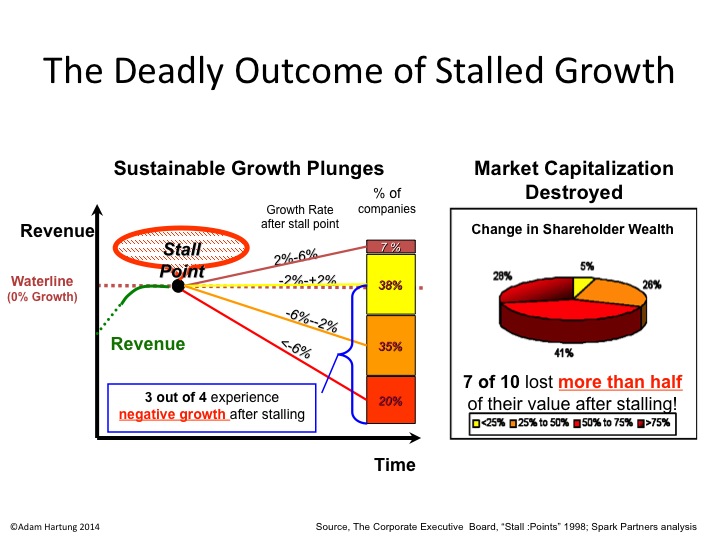
A Growth Stall occurs when a company has 2 consecutive quarters of declining sales or earnings, or 2 consecutive quarters of lower sales or earnings than the previous year. And our research, in conjunction with The Conference Board, proved that when this happens the future becomes fairly easy to predict.
Growth Stalls are Deadly
When companies hit a growth Stall, 93% of the time they are unable to maintain even a 2% growth rate. 55% fall into a consistent revenue decline of more than 2%. 1 in 5 drop into a negative 6%/year revenue slide. 69% of Growth Stalled companies will lose at least half their market capitalization in just a few years. 95% will lose more than 25% of their market value.
Back in February, McDonalds sales in USA stores open at least 13 months fell 1.4%. By May these same stores reported reported their 7th consecutive month (now more than 2 quarters) of declining revenues. And in July McDonald’s reported the worst sales decline in over a decade – with stores globally selling 2.5% less (USA stores were down 3.2% for the month.) McDonald’s leadership is now warning that annual sales will be weaker than forecast – and could well be a reported decline.
While McDonald’s has been saying that Asian store revenue growth had offset the USA declines, we now can see that the USA drop is the key signal of a stall. There was no specific program in Asia to indicate that offshore revenues could create a renewed uptick in USA sales. Now with offshore sales plummeting we can see that McDonald’s American performance is the lead indicator of a company with serious performance issues.
Growth Stalls are a great forecasting tool because they indicate when a company has become “out of step” with its marketplace. While management, and in fact many analysts, will claim that this performance deficit is a short term aberration which will be repaired in coming months, historical evidence — and a plethora of case stories – tell us that in fact by the time a Growth Stall shows itself (especially in a company as large as McDonald’s) the situation is far more dire (and systemic) than management would like investors to believe.
Something fundamental has happened in the marketplace, and company leadership is busy trying to defend its historical business in the face of a major change that is pulling customers toward substitute solutions. Frequently this defend & extend approach exacerbates the problems as retrenchment efforts further hurt revenues.
McDonald’s has reached this inflection point as the result of a long string of leadership decisions which have worked to submarine long-term value.
Back in 2006 McDonald’s sold its fast growing Chipotle chain in order to raise additional funds to close some McDonald’s stores, and undertake an overhaul of the supply chain as well as many remaining stores. This one-time event was initially good for McDonald’s, but it hurt shareholders by letting go of an enormously successful revenue growth machine.
Since that sale Chipotle has outperformed McDonalds by 3x, and it was clear in 2011 that investors were better off with the faster growing Chipotle than the operationally focused McDonald’s. Desperate for revenues as its products lagged changing customer tastes, by December, 2012 McDonald’s was urging franchisees to stay open on Christmas Day in order to add just a bit more to the top line. However, such operational tactics cannot overcome a product line that is fat-and-carb-heavy and off current customer food trends, and by this July was ranked the worst burger in the marketplace. Meanwhile McDonald’s customer service this June ranked dead last in the industry. All telltale signs of the problems creating the emergent Growth Stall.
Meanwhile, McDonald’s is facing a significant attack on its business model as trends turn toward higher minimum wages. By August, 2013 the first signs of the trend were clear – and the impact on McDonald’s long-term fortunes were put in question. By February, 2014 the trend was accelerating, yet McDonald’s continued ignoring the situation. And this month the issue has become a front-and-center problem for McDonald’s investors as the National Labor Relations Board (NLRB) has said it will not separate McDonald’s from its franchisees in pay and hours disputes – something which opens McDonald’s deep pockets to litigants looking to build on the living wage trend.
The McDonald’s CEO is somewhat “under seige” due to the poor revenue and earnings reports. Yet, the company continues to ascribe its Growth Stall to short-term problems such as a meat processing scandal in China. But this inverts the real situation. Such scandals are not the cause of current poor results. Rather, they are the outcome of actions taken to meet goals set by leadership pushing too hard, trying to achieve too much, by defending and extending an outdated success formula desperately in need of change to meet new competitive market conditions.
Application of Growth Stall analysis has historically been very valuable. In May, 2009 I reported on the Growth Stall at Motorola which threatened to dramatically lower company value. Subsequently Motorola spun off its money losing phone business, sold other assets and businesses, and is now a very small remnant of the business prior to its Growth Stall; which was brought on by an overwhelming market shift to smartphones from 2-way radios and traditional cell phones.
In February, 2008 a Growth Stall at General Electric indicated the company would struggle to reach historical performance for long-term investors. The stock peaked at $57.80 in 2000, then at $41.40 in July, 2007. By January, 2009 (post Stall) the company had crashed to only $10, and even recent higher valuations ($28 in 10/2013) are still far from the all-time highs – or even highs in the last decade.
In May, 2008 the Growth Stall at AIG portended big problems for the Dow Jones Industrial (DJIA) giant as financial markets continued to shift radically and quickly. By the end of 2008 AIG stock cratered and the company was forced to wipe out shareholders completely in a government-backed restructuring.
Perhaps the most compelling case has been Microsoft. By February, 2010 a Growth Stall was impending (and confirmed by May, 2011) warning of big changes for the tech giant. Mobile device sales exploded, sending Apple and Google stocks soaring, while Microsoft’s primary, core market for PCs (and software for PCs) has fallen into decline. Windows 8 subsequently had a tepid market acceptance, and gained no traction in mobile devices, causing Microsoft to write-off its investment in the Surface tablet. Recent announcements about enormous lay-offs, with vast cuts in the acquired Nokia handheld unit, do not bode well for long-term revenue growth at the decaying (yet cash rich) giant.
As the Dow has surged to record highs, it has lifted all boats. Including those companies which are showing serious problems. It is easy to look at the ubiquity of McDonald’s stores and expect the chain to remain forever dominant. But, the company is facing serious strategic problems with its products, service and business model which leadership has shown no sign of addressing. The recent Growth Stall serves as a key long-term indicator that McDonald’s is facing serious problems which will most likely seriously jeopardize investors’ (as well as employees’, suppliers’ and supporting communities’) potential returns.