by Adam Hartung | May 25, 2011 | Defend & Extend, Disruptions, In the Swamp, Innovation, Leadership, Lock-in, Openness, Transparency, Web/Tech
Nobody admits to being the innovation killer in a company. But we know they exist. Some these folks “dinosaurs that won’t change.” Others blame “the nay-saying ‘Dr. No’ middle managers.” But when you meet these people, they won’t admit to being innovation killers. They believe, deep in their hearts as well as in their everyday actions, that they are doing the right thing for the business. And that’s because they’ve been chosen, and reinforced, to be the Status Quo Police.
When a company starts it has no norms. But as it succeeds, in order to grow quickly it develops a series of “key success factors” that help it continue growing. In order to grow faster, managers – often in functional roles – are assigned the task of making sure the key success factors are unwaveringly supported. Consistency becomes more important than creativity. And these managers are reinforced, supported, even bonused for their ability to make sure they maintain the status quo. Even if the market has shifted, they don’t shift. They reinforce doing things according to the rules. Just consider:
Quality – Who can argue with the need to have quality? Total Quality Management (TQM,) Continuous Improvement (CI,) and Six Sigma programs all have been glorified by companies hoping to improve product or service quality. If you’re trying to fix a broken product, or process, these work pretty well at helping everyone do their job better.
But these programs live with the mantra “if you can’t measure it, you can’t improve it. Measure everything that’s important.” If you’re innovating, what do you measure? If you’re in a new technology, or manufacturing process, how do you know what you really need to do right? If you’re in a new market, how do you know the key metric for sales success? Is it number of customers called, time with customers, number of customer surveys, recommendation scores, lost sales reports? When you’re trying to do something new, a lot of what you do is respond quickly to instant feedback – whether it’s good feedback or bad.
The key to success isn’t to have critical metrics and measure performance on a graph, but rather to learn from everything you do – and usually to change. Quality people hate this, and can only stand in the way of trying anything new because you don’t know what to measure, or what constitutes a “good” measure. Don’t ever forget that Motorola pretty much invented Six Sigma, and what happened to them in the mobile phone business they pioneered?
Finance. All businesses exist to make money, so who can argue with “show me the numbers. Give me a business plan that shows me how you’re going to make money.” When your’e making an incremental investment to an existing asset or process, this is pretty good advice.
But when you’re innovating, what you don’t know far exceeds what you know. You don’t know how to meet unment needs. You don’t know the market size, the price that people will pay, the first year’s volume (much less year 5,) the direct cost at various volumes, the indirect cost, the cost of marketing to obtain customer attention, the number of sales calls it will take to land a sale, how many solution revisions will be necessary to finally put out the “right” solution, or how sales will ramp up quarterly from nothing. So to create a business plan, you have to guess.
And, oh boy, then it gets ugly. “Where did this number come from? That one? How did you determine that?” It’s not long until the poor business plan writer is ridden out of the meeting on a rail. He has no money to investigate the market, so he can’t obtain any “real” numbers, so the business plan process leads to ongoing investment in the old business, while innovation simply stalls.
Under Akia Morita Sony was a great innovator. But then an MBA skilled in finance took over the top spot. What once was the #1 electronics innovator in the globe has become, well, let’s say they aren’t Apple.
Legal – No company wants to be sued, or take on unnecessary risk. And when you’re selling something, lawyers are pretty good at evaluating the risk in that business, and lowering the risk. While making sure that all the compliance issues are met in order to keep regulators – and other lawyers – out of the business.
But when you’re starting something new, everything looks risky. Customers can sue you for any reason. Suppliers can sue you for not taking product, or using it incorrectly. The technology could fail, or have negative use repercussions. Reguators can question your safety standards, or claims to customers.
From a legal point of view, you’re best to never do anything new. The less new things you do, the less likely you are to make a mistake. So legal’s great at putting up roadblocks to make sure they protect the company from lawsuits, by making sure nothing really new happens. The old General Motors had plenty of lawyers making sure their cars were never too risky – or interesting.
R&D or Product Development – Who doesn’t think it’s good to be a leader in a specific technology? Technology advances have proven invaluable for companies in industries from computers to pharmaceuticals to tractors and even services like on-line banking. Thus R&D and Product Development wants to make sure investments advance the state of the technology upon which the company was built.
But all technologies become obsolete. Or, at least unprofitable. Innovators are frequently on the front end of adopting new technologies. But if they have to obtain buy-in from product development to obtain staffing or money they’ll be at the end of a never-ending line of projects to sustain the existing development trend. You don’t have to look much further than Microsoft to find a company that is great at pouring money into the PC platform (some $9B, 16% of revenue in 2009,) while the market moves faster each year to mobile devices and entertainment (Apple spent 1/8th the Microsoft budget in 2009.)
Sales, Marketing & Distribution – When you want to protect sales to existing customers, or maybe increase them by 5%, then doing more of what you’ve always done is smart. So money is spent to put more salespeople on key accounts, add more money to the advertising budget for the most successful (or most profitable) existing products. There are more rules about using the brand than lighters at a smoker’s convention. And it’s heresy to recommend endangering the distribution channel that has so successfully helped increase sales.
But innovators regularly need to behave differently. They need to sell to different people – Xerox sold to secretaries while printing press manufacturers sold to printers. The “brand” may well represent a bygone era, and be of no value to someone launching a new product; are you eager to buy a Zenith electronic device? Sprucing up the brand, or even launching something new, may well be a requirement for a new solution to be taken seriously.
And often, to be successful, a new solution needs to cut through the old, high-cost distribution system directly to customers if it is to succeed. Pre-Gerstner IBM kept adding key account sales people in hopes of keeping IT departments from switching out of mainframes to PCs. Sears avoided the shift to on-line sales successfully – and revenue keeps dropping in the stores.
Information Technology – To make more money you automate more functions. Computers are wonderful for reducing manpower in many tasks. So IT implements and supports “standard solutions” that are cost effective for the historical business. Likewise, they set up all kinds of user rules – like don’t go to Facebook or web sites from work – to keep people focused on productivity. And to make sure historical data is secure and regulations are met.
But innovators don’t have a solution mapped out, and all that automated functionality is an enormously expensive headache. When being creative, more time is spent looking for something new than trying to work faster, or harder, so access to more external information is required. Since the solution isn’t developed, there’s precious little to worry about keeping secure. Innovators need to use new tools, and have flexibility to discover advantageous ways to use them, that are far beyond the bounds of IT’s comfort zone.
Newspapers are loaded with automated systems to collect and edit news, to enter display ads, and to “Make up” the printed page fast and cheap. They have automated systems for classified advertising sales and billing, and for display ad billing. And systems to manage subscribers. That technology isn’t very helpful now, however, as newspapers go bankrupt. Now the most critical IT skills are pumping news to the internet in real-time, and managing on-line ads distributed to web users that don’t have subscriptions.
Human Resources – Growth pushes companies toward tighter job descriptions with clear standards for “the kinds of people that succeed around here.” When you want to hire people to be productive at an existing job, HR has the procedures to define the role, find the people and hire them at the most efficient cost. And they can develop a systematic compensation plan that treats everyone “fairly” based upon perceived value to the historical business.
But innovators don’t know what kinds of people will be most successful. Often they need folks who think laterally, across lots fo tasks, rather than deeply about something narrow. Often they need people who are from different backgrounds, that are closer to the emerging market than the historical business. And pay has to be related to what these folks can get in the market, not what seems fair through the lens of the historical business. HR is rarely keen to staff up a new business opportunity with a lot of misfits who don’t appreciate their compensation plan – or the rules so carefully created to circumscribe behavior around the old business.
B.Dalton was America’s largest retail book seller when Amazon.com was founded by Jeff Bezos. Jeff knew nothing about books, but he knew the internet. B.Dalton knew about books, and claimed it knew what book buyers wanted. Two years later B.Dalton went bankrupt, and all those book experts became unemployed. Amazon.com now sells a lot more than books, as it ongoingly and rapidly expands its employee skill sets to enter new markets – like publishing and eReaders.
Innovation requires that leaders ATTACK the Status Quo Police. Everything done to efficiently run the old business is irrelevant when it comes to innovation. Functional folks need to be told they can’t force the innovatoirs to conform to old rules, because that’s exactly why the company needs innovation! Only by attacking the old rules, and being willing to allow both diversity and disruption can the business innovate.
Instead of saying “this isn’t how we do things around here” it is critical leaders make sure functional folks are saying “how can I help you innovate?” What was done in the name of “good business” looks backward – not forward. Status Quo cops have to be removed from the scene – kept from stopping innovation dead in its tracks. And if the internal folks can’t be supportive, that means keeping them out of the innovator’s way entirely.
Any company can innovate. Doing so requires recognizing that the Status Quo Police are doing what they were hired to do. Until you take away their clout, attack their role and stop them from forcing conformance to old dictums, the business can’t hope to innovate.
by Adam Hartung | May 16, 2011 | Defend & Extend, In the Swamp, Leadership, Lifecycle, Lock-in, Web/Tech
In “Screening Large Cap Value Stocks” 24x7WallSt.com tries making the investment case for Dell. And backhandedly, for Hewlett Packard. The argument is as simple as both companies were once growing, but growth slowed and now they are more mature companies migrating from products into services. They have mounds of cash, and will soon start paying a big, fat dividend. So investors can rest comfortably that these big companies are a good value, sitting on big businesses, and less risky than growth stocks.
Nice story. Makes for good myth. Reality is that these companies are a lousy value, and very risky.
Dell grew remarkably fast during the PC growth heyday. Dell innovated computer sales, eschewing expensive distribution for direct-to-customer marketing and order-taking. Dell could sell individuals, or corporations, computers off-the-shelf or custom designed machines in minutes, delivered in days. Further, Dell eschewed the costly product development of competitors like Compaq in favor of using a limited number of component suppliers (Microsoft, Intel, etc.) and focusing on assembly. With Wal-Mart style supply chain execution Dell could deliver a custom order and be paid before the bill was due for parts. Quickly Dell was a money-making, high growth machine as it rode the growth of PC sales expansion.
But competitors learned to match Dell’s supply chain cost-cutting capabilities. Manufacturers teamed with retailers like Best Buy to lower distribution cost. As competition copied the use of common components product differences disappeared and prices dropped every month. Dell’s advantages started disappearing, and as they continued to follow the historical cost-cutting success formula with more outsourcing, problems developed across customer services. Competitors wreaked havoc on Dell’s success formula, hurting revenue growth and margins.
HP followed a similar path, chasing Dell down the cost curve and expanding distribution. To gain volume, in hopes that it would create “scale advantages,” HP acquired Compaq. But the longer HP poured printer profits into PCs, the more it fed the price war between the two big companies.
Worst for both, the market started shifting. People bought fewer PCs. Saturation developed, and reasons to buy new ones were few. Users began buying more smartphones, and later tablets. And neither Dell nor HP had any products in development where the market was headed, nor did their “core” suppliers – Microsoft or Intel.
That’s when management started focusing on how to defend and extend the historical business, rather than enter growth markets. Rather than moving rapidly to push suppliers into new products the market wanted, both extended by acquiring large consulting businesses (Dell famously bought Perot Systems and HP bought EDS) in the hopes they could defend their PC installed base and create future sales. Both wanted to do more of what they had always done, rather than shift with emerging market needs.
But not only product sales were stagnating. Services were becoming more intensely competitive – from domestic and offshore services providers – hampering sales growth while driving down margins. Hopes of regaining growth in the “core” business – especially in the “core” enterprise markets – were proving illusory. Buyers didn’t want more PCs, or more PC services. They wanted (and now want) new solutions, and neither Dell nor HP is offering them.
So the big “cash hoard” that 24×7 would like investors to think will become dividends is frittered away by company leadership – spent on acquisitions, or “special projects,” intended to save the “core” business. When allocating resources, forecasts are manipulated to make defensive investments look better than realistic. Then the “business necessity” argument is trotted out to explain why acquisitions, or price reductions, are necessary to remain viable, against competitors, even when “the numbers” are hard to justify – or don’t even add up to investor gains. Instead of investing in growth, money is spent trying to delay the market shift.
Take for example Microsoft’s recent acquisition of Skype for $8.5B. As Arstechnia.com headlined “Why Skype?” This acquisition is another really expensive effort by Microsoft to try keeping people using PCs. Even though Microsoft Live has been in the market for years, Microsoft keeps trying to find ways to invest in what it knows – PCs – rather than invest in solutions where the market is shifting. New smartphone/tablet products come with video capability, and are already hooked into networks. Skype is the old generation technology, now purchased for an enormous sum in an effort to defend and extend the historical base.
There is no doubt people are quickly shifting toward smartphones and tablets rather than PCs. This is an irreversable trend:  Chart source BusinessInsider.com
Executive teams locked-in to defending their past spend resources over-investing in the old market, hoping they can somehow keep people from shifting. Meanwhile competitors keep bringing out new solutions that make the old obsolete. While Microsoft was betting big on Skype last week Mediapost.com headlined “Google Pushes Chromebook Notebooks.” In a direct attack on the “core” customers of Dell and HP (and Microsoft) Google is offering a product to replace the PC that is far cheaper, easier to use, has fewer breakdowns and higher user satisfaction.
Chromebooks don’t have to replace all PCs, or even a majority, to be horrific for Dell and HP. They just have to keep sucking off all the growth. Even a few percentage points in the market throws the historical competitors into further price warring trying to maintain PC revenues – thus further depleting that cash hoard. While the old gladiators stand in the colliseum, swinging axes at each other becoming increasingly bloody waiting for one to die, the emerging competitors avoid the bloodbath by bringing out new products creating incremental growth.
People love to believe in “value stocks.” It sounds so appealing. They will roll along, making money, paying dividends. But there really is no such thing. New competitors pressure sales, and beat down margins. Markets shift wtih new solutions, leaving fewer customers buying what all the old competitors are selling, further driving down margins. And internal decision mechanisms keep leadership spending money trying to defend old customers, defend old solutions, by making investments and acquisitions into defensive products extending the business but that really have no growth, creating declining margins and simply sucking away all that cash. Long before investors have a chance to get those dreamed-of dividends.
This isn’t just a high-tech story. GM dominated autos, but frittered away its cash for 30 years before going bankrupt. Sears once dominated retailing, now its an irrelevent player using its cash to preserve declining revenues (did you know Woolworth’s was a Dow Jones company until 1997?). AIG kept writing riskier insurance to maintain its position, until it would have failed if not for a buyout. Kodak never quit investing in film (remember 110 cameras? Ektachrome) until competitors made film obsolete. Xerox was the “copier company” long after users switched to desktop publishing and now paperless offices.
All of these were once called “value investments.” However, all were really traps. Although Dell’s stock has gyrated wildly for the last decade, investors have lost money as the stock has gone from $25 to $15. HP investors have fared a bit better, but the long-term trending has only had the company move from about $40 to $45. Dell and HP keep investing cash in trying to find past glory in old markets, but customers shift to the new market and money is wasted.
When companies stop growing, it’s because markets shift. After markets shift, there isn’t any value left. And management efforts to defend the old success formula with investments in extensions simply fritter away investor money. That’s why they are really value traps. They are actually risky investments, because without growth there is little likelihood investors will ever see a higher stock price, and eventually they always collapse – it’s just a matter of when. Meanwhile, riding the swings up and down is best left for day traders – and you sure don’t want to be long the stock when the final downturn hits.
by Adam Hartung | May 10, 2011 | Current Affairs, In the Whirlpool, Innovation, Leadership, Lifecycle
Sears is threatening to move its headquarters out of the Chicago area. It’s been in Chicago since the 1880s. Now the company Chairman is threatening to move its headquarters to another state, in order to find lower operating costs and lower taxes.
Predictably “Officals Scrambling to Keep Sears in Illinois” is the Chicago Tribune headlined. That is stupid. Let Sears go. Giving Sears subsidies would be tantamount to putting a 95 year old alcoholic, smoking paraplegic at the top of the heart/lung transplant list! When it comes to subsidies, triage is the most important thing to keep in mind. And honestly, Sears ain’t worth trying to save (even if subsidies could potentially do it!)
“Fast Eddie Lampert” was the hedge fund manager who created Sears Holdings by using his takeover of bankrupt KMart to acquire the former Sears in 2003. Although he was nothing more than a financier and arbitrager, Mr. Lampert claimed he was a retailing genius, having “turned around” Auto Zone. And he promised to turn around the ailing Sears. In his corner he had the modern “Mad Money” screaming investor advocate, Jim Cramer, who endorsed Mr. Lampert because…… the two were once in college togehter. Mr. Cramer promised investors would do well, because he was simply sure Mr. Lampert was smart. Even if he didn’t have a plan for fixing the company.
Sears had once been a retailing goliath, the originator of home shopping with the famous Sears catalogue, and a pioneer in financing purchases. At one time you could obtain all your insurance, banking and brokerage needs at a Sears, while buying clothes, tools and appliances. An innovator, Sears for many years was part of the Dow Jones Industrial Average. But the world had shifted, Home Depot displaced Sears on the DJIA, and the company’s profits and revenues sagged as competitors picked apart the product lines and locations.
Simultaneously KMart had been destroyed by the faster moving and more aggressive Wal-Mart. Wal-Mart’s cost were lower, and its prices lower. Even though KMart had pioneered discount retailing, it could not compete with the fast growing, low cost Wal-Mart. When its bonds were worth pennies, Mr. Lampert bought them and took over the money-losing company.
By combining two losers, Mr. Lampert promised he would make a winner. How, nobody knew. There was no plan to change either chain. Just a claim that both were “great brands” that had within them other “great brands” like Martha Stewart (started before she was convicted and sent to jail), Craftsman and Kenmore. And there was a lot of real estate. Somehow, all those assets simlply had to be worth more than the market value. At least that’s what Mr. Lampert said, and people were ready to believe. And if they had doubts, they could listen to Jim Cramer during his daily Howard Beale impersonation.
Only they all were wrong.
Retailing had shifted. Smarter competitors were everywhere. Wal-Mart, Target, Dollar General, Home Depot, Best Buy, Kohl’s, JCPenney, Harbor Freight Tools, Amazon.com and a plethora of other compeltitors had changed the retail market forever. Likewise, manufacturers in apparel, appliances and tools had brough forward better products at better prices. And financing was now readily available from credit card companies.
Surely the real estate would be worth a fortune everyone thought. After all, there was so much of it. And there would never be too much retail space. And real estate never went down in value. At least, that’s what everyone said.
But they were wrong. Real estate was at historic highs compared to income, and ability to pay. Real estate was about to crater. And hardest hit in the commercial market was retail space, as the “great recession” wiped out home values, killed personal credit lines, and wiped out disposable income. Additionally, consumers increasingly were buying on-line instead of trudging off to stores fueling growth at Amazon and its peers rather than Sears – which had no on-line presence.
Those who were optimistic for Sears were looking backward. What had once been valuable they felt surely must be valuable again. But those looking forward could see that market shifts had rendered both KMart and Sears obsolete. They were uncompetitive in an increasingly more competitive marketplace. As competitors kept working harder, doing more, better, faster and cheaper Sears was not even in the game. The merger only made the likelihood of failure greater, because it made the scale fo change even greater.
The results since 2003 have been abysmal. Sales per store, a key retail benchmark, have declined every quarter since Mr. Lampert took over. In an effort to prove his financial acumen, Mr. Lampert led the charge for lower costs. And slash his management team did – cutting jobs at stores, in merchandising and everywhere. Stores were closed every quarter in an effort to keep cutting costs. All Mr. Lampert discussed were earnings, which he kept trying to keep from disintegrating. But with every quarter Sears has become smaller, and smaller. Now, Crains Chicago Business headlined, even the (in)famous chairman has to admit his past failure “Sears Chief Lampert: We Ought to be Doing a Lot Better.”
Sears once built, and owned, America’s tallest structure. But long ago Sears left the Sears Tower. Now it’s called the Willis Tower by the way – there is no Sears Tower any longer. Sears headquarters are offices in suburban Hoffman Estates, and are half empty. Eighty percent of the apparel merchandisers were let go in a recent move, taking that group to California where the outcome has been no better. Constant cost cutting does that. Makes you smaller, and less viable.
And now Sears is, well….. who cares? Do you even know where the closest Sears or Kmart store is to you? Do you know what they sell? Do you know the comparative prices? Do you know what products they carry? Do you know if they have any unique products, or value proposition? Do you know anyone who works at Sears? Or shops there? If the store nearest you closed, would you miss it amidst the Home Depot, Kohl’s or Best Buy competitors? If all Sears stores closed – every single location – would you care?
And now Illinois is considering giving this company subsidies to keep the headquarters here?
Here’s an alternative idea. Using whatever logic the state leaders can develop, using whatever dream scenario and whatever desperation economics they have in mind to save a handful of jobs, figure out what the subsidy might be. Then invest it in Groupon. Groupon is currently the most famous technology start-up in Illinois. Over the next 10 years the Groupon investment just might create a few thousand jobs, and return a nice bit of loot to the state treasury. The Sears money will be gone, and Sears is going to disappear anyway. Really, if you want to give a subsidy, if you want to “double down,” why not bet on a winner?
It really doesn’t have to be Groupon. The state residents will be much better off if the money goes into any business that is growing. Investing in the dying horse simply makes no sense. Beg Amazon, Google or Apple to open a center in Illinois – give them the building for free if you must. At least those will be jobs that won’t disappear. Or invest the money into venture funds that can invest in the next biotech or other company that might become a Groupon. Invest in senior design projects from engineering students at the University of Illinois in Chicago or Urbana/Champaign. Invest in the fillies that have a chance of winning the race!
Sentimenatality isn’t bad. We all deserve the right to “remember the good old days.” But don’t invest your retirement fund, or state tax receipts, in sentimentality. That’s how you end up like Detroit. Instead put that money into things that will grow. So you can be more like silicon valley. Invest in businesses that take advantage of market shifts, and leverage big trends to grow. Let go of sentimentality. And let go of Sears. Before it makes you bankrupt!
by Adam Hartung | May 3, 2011 | Current Affairs, Defend & Extend, In the Swamp, Leadership, Lock-in, Web/Tech
For the first time in 20 years, Apple’s quarterly profit exceeded Microsoft’s (see BusinessWeek.com “Microsoft’s Net Falls Below Apple As iPad Eats Into Sales.) Thus, on the face of things, the companies should be roughly equally valued. But they aren’t. This week Microsoft’s market capitalization is about $215B, while Apple’s is about $365B – about 70% higher. The difference is, of course, growth – and how a lack of it changes management!
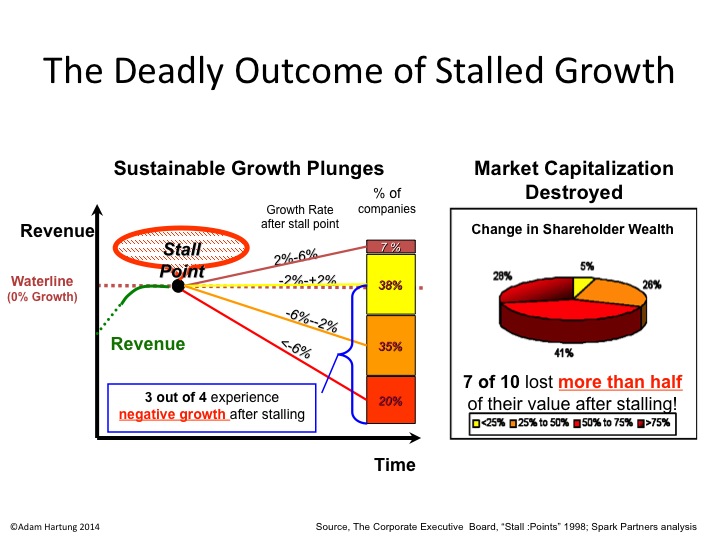
According to the Conference Board, growth stalls are deadly.
When companies hit a growth stall, 93% of the time they are unable to maintain even a 2% growth rate. 75% fall into a no growth, or declining revenue environment, and 70% of them will lose at least half their market capitalization. That’s because the market has shifted, and the business is no longer selling what customers really want.
At Microsoft, we see a company that has been completely unable to deal with the market shift toward smartphones and tablets:
- Consumer PC shipments dropped 8% last quarter
- Netbook sales plunged 40%
Quite simply, when revenues stall earnings become meaningless. Even though Microsoft earnings were up, it wasn’t because they are selling what customers really want to buy. In stalled companies, executives cut costs in sales, marketing, new product development and outsource like crazy in order to prop up earnings. They can outsource many functions. And they go to the reservoir of accounting rules to restate depreciation and expenses, delaying expenses while working to accelerate revenue recognition.
Stalled company management will tout earnings growth, even though revenues are flat or declining. But smart investors know this effort to “manufacture earnings” does not create long-term value. They want “real” earnings created by selling products customers desire; that create incremental, new demand. Success doesn’t come from wringing a few coins out of a declining market – but rather from being in markets where people prefer the new solutions.
Mobile phone sales increased 20% (according to IDC), and Apple achieved 14% market share – #3 – in USA (according to MediaPost.com) last quarter. And in this business, Apple is taking the lion’s share of the profits:

Image provided by BusinessInsider.com
When companies are growing, investors like that they pump earnings (and cash) back into growth opportunities. Investors benefit because their value compounds. In a stalled company investors would be better off if the company paid out all their earnings in dividends – so investors could invest in the growth markets.
But, of course, stalled companies like Microsoft and Research in Motion, don’t do that. Because they spend their cash trying to defend the old business. Trying to fight off the market shift. At Microsoft, money is poured into trying to protect the PC business, even as the trend to new solutions is obvious. Microsoft spent 8 times as much on R&D in 2009 as Apple – and all investors received was updates to the old operating system and office automation products. That generated almost no incremental demand. While revenue is stalling, costs are rising.
At Gurufocus.com the argument is made “Microsoft Q3 2011: Priced for Failure“. Author Alex Morris contends that because Microsoft is unlikely to fail this year, it is underpriced. Actually, all we need to know is that Microsoft is unlikely to grow. Its cost to defend the old business is too high in the face of market shifts, and the money being spent to defend Microsoft will not go to investors – will not yield a positive rate of return – so investors are smart to get out now!
Additionally, Microsoft’s cost to extend its business into other markets where it enters far too late is wildly unprofitable. Take for example search and other on-line products: 
Chart source BusinessInsider.com
While much has been made of the ballyhooed relationship between Nokia and Microsoft to help the latter enter the smartphone and tablet businesses, it is really far too late. Customer solutions are now in the market, and the early leaders – Apple and Google Android – are far, far in front. The costs to “catch up” – like in on-line – are impossibly huge. Especially since both Apple and Google are going to keep advancing their solutions and raising the competitive challenge. What we’ll see are more huge losses, bleeding out the remaining cash from Microsoft as its “core” PC business continues declining.
Many analysts will examine a company’s earnings and make the case for a “value play” after growth slows. Only, that’s a mythical bet. When a leader misses a market shift, by investing too long trying to defend its historical business, the late-stage earnings often contain a goodly measure of “adjustments” and other machinations. To the extent earnings do exist, they are wasted away in defensive efforts to pretend the market shift will not make the company obsolete. Late investments to catch the market shift cost far too much, and are impossibly late to catch the leading new market players. The company is well on its way to failure, even if on the surface it looks reasonably healthy. It’s a sucker’s bet to buy these stocks.
Rarely do we see such a stark example as the shift Apple has created, and the defend & extend management that has completely obsessed Microsoft. But it has happened several times. Small printing press manufacturers went bankrupt as customers shifted to xerography, and Xerox waned as customers shifted on to desktop publishing. Kodak declined as customers moved on to film-less digital photography. CALMA and DEC disappeared as CAD/CAM customers shifted to PC-based Autocad. Woolworths was crushed by discount retailers like KMart and WalMart. B.Dalton and other booksellers disappeared in the market shift to Amazon.com. And even mighty GM faltered and went bankrupt after decades of defend behavior, as customers shifted to different products from new competitors.
Not all earnings are equal. A dollar of earnings in a growth company is worth a multiple. Earnings in a declining company are, well, often worthless. Those who see this early get out while they can – before the company collapses.
Update 5/10/11 – Regarding announced Skype acquisition by Microsoft
That Microsoft has apparently agreed to buy Skype does not change the above article. It just proves Microsoft has a lot of cash, and can find places to spend it. It doesn’t mean Microsoft is changing its business approach.
Skype provides PC-to-PC video conferencing. In other words, a product that defends and extends the PC product. Exactly what I predicted Microsoft would do. Spend money on outdated products and efforts to (hopefully) keep people buying PCs.
But smartphones and tablets will soon support video chat from the device; built in. And these devices are already connected to networks – telecom and wifi – when sold. The future for Skype does not look rosy. To the contrary, we can expect Skype to become one of those features we recall, but don’t need, in about 24 to 36 months. Why boot up a PC to do a video chat you can do right from your hand-held, always-on, device?
The Skype acquisition is a predictable Defend & Extend management move. It gives the illusion of excitement and growth, when it’s really “so much ado about nothing.” And now there are $8.5B fewer dollars to pay investors to invest in REAL growth opportunities in growth markets. The ongoing wasting of cash resources in an effort to defend & extend, when the market trends are in another direction.
by Adam Hartung | Apr 29, 2011 | Current Affairs, In the Rapids, Innovation, Leadership, Web/Tech
CIO Magazine today published my latest article for IT professionals “Why You Should Stop Worrying and Let End Users Have iPads.” (note: free site registration may be required to read the full article)
The editors at CIO agreed with me that a big change is happening in “enterprise IT.” User technology is now so cheap, and good, that employees no longer depend upon corporate IT to provide them with their productivity tools. When you can buy a smartphone for $100, and a tablet for $500, increasingly users are happy to supply their own, private, productivity tools rather than try using something they find larger, heavier and harder to use from their boss — and also something which they’ve been told for years should not have personal items on it.
The serious impact is that increasingly the users feel “burdened” by corporate IT. They become less accessible as they leave the company laptop at work – and shut off the company Blackberry after work hours. They complain about the inefficiency of corporate tools, while using personal phones and tablets to do internet searches, access networks for fast info sharing (Facebook, Twitter, Linked-in), and generally find greatest productivity by ignoring technology supplied by employers. Often tehnology that is incredibly expensive.
Leading companies are taking advantage of this trend, and supplying the latest devices to employees. They recognize that greatest good comes not from “controlling” employee technology use. Rather, productivity is greatly enhanced by encouraging employees to take advantage of newest technology in the course of their work. Thus, leaders are providing iPhones and iPads, and giving access to Facebook and YouTube through the company network.
The world of IT shifts fast. Changes in IT have often seperated winners from losers. IT leaders have to change their mindsets if they want to help their companies profitably grow. And the first step is giving users technology they want, rather than technology they too often despise.
You can also access this article by clicikng on links to the following journals:
I look forward to your opinion about this topic! Do you think IT departmernts are slow to react to new tools? Do you think the new tools are “enterprise ready?” Do you think the advantages of newer techbnology outweigh potential IT risks? Drop comments here, or on the article pages! Love to hear what others think
by Adam Hartung | Apr 26, 2011 | Defend & Extend, In the Rapids, In the Swamp, Innovation, Leadership, Lock-in, Web/Tech
Summary:
- Everyone discriminates in hiring – just some is considered bad, and some considered good
- Only “good discrimination” inevitably leads to homogeneity and “group think” leaving the business vulbnerable to market shifts
- Efforts to defend & extend the historical success formula moves beyond hiring to include using internal bias to favor improvement projects and disfavor innovations
- Amazon has grown significantly more than Wal-Mart, and it’s value has quadrupled while Wal-mart’s has been flat, because it has moved beyond its original biases
The long list of people attacking Wal-Mart includes a class-action law suit between former female workers and their employer. The plaintiffs claim Wal-Mart systematically was biased, via its culture, to pay women less and limit their promotion opportunities. The case is prompting headlines like BNet.com‘s “Does Your Company Help You Discriminate?”
Actually, all cultures – and hiring programs – are designed to discriminate. It’s just that some discrimination is legal, and some is not. At Google it’s long been accepted that the bias is toward quant jocks and those with highest IQs. That’s not illegal. Saying that men, or white people, or Christians make better employees is illegal. But there is risk in all hiring bias – even the legal kind. To avoid the illegal discrimination, its smarter to overcome the “natural bias” that cultures create for hiring. And the good news is that this is better for the business’s growth and rate of return!
Successful organizations build a profile of “who did well around here – and why” as they grow. It doesn’t take long until that profile is what they seek. The downside is that quickly there’s not a lot of heterogeneity in the hiring – or the workforce. That leads to “group think,” which reinforces “not invented here.” Everyone becomes self-assured of their past success, and believes that if they keep doing “more of the same” the future will work out fine. Whether Wal-Mart’s hiring biases were legal – or not – it is clear that the group think created at Wal-Mart has kept it from innovating and moving into new markets with more growth.
Markets shift. New products, technologies and business practices emerge. New competitors figure out ways of providing new solutions. Customers drift toward new offerings, and growth slows. Unfortunately, bias keeps the early winner from accepting this market shift – so the company falls into serious growth troubles trying to do more, better, faster, cheaper of what worked before. Look at Dell, still trying to compete in PCs with its supply chain focus long after competitors have matched their pricing and started offering superior customer service and other advantages. Meanwhile, the market growth has moved away from PCs into products (tablets, smartphones) Dell doesn’t even sell.
Wal-Mart excels at its success formula of big, boring, low price stores. And its bias is to keep doing more of the same. Only, that’s not where the growth is in retailing any longer. The market for “cheap” is pretty well saturated, and now filled with competitors that go one step further being cheap (like Dollar General,) or largely match the low prices while offering better store experience (like Target) or better selection and varied merchandise (like Kohl’s). Wal-Mart is stuck, when it needs to shift. But its bias toward “doing what Sam Walton did that made us great” has now made Wal-Mart the target for every other retailer, and stymied Wal-Mart’s growth.
A powerful sign of status quo bias shows itself when leaders and managers start overly relying on “how we’ve done things here” and “the numbers.” The former leads to accepting recommendations fro hiring and promotion based upon similarity with previous “winners.” Investment opportunities to defend and extend what’s always been done sail through reviews, because everyone understands the project and everyone believes that the results will appear.
Nearly all studies of operational improvement projects show that returns rarely achieve the anticipated outcomes. Because these projects reinforce the status quo, they are assumed to be highly accurate projections. But planned efficiences do not emerge. Headcount reductions do not happen. Unanticipated costs emerge. And, most typically, competitors copy the project and achieve the same results, leading to price reductions across the board benefitting customers rather than company profits.
Doing more of the same is easily approved and rarely questioned – whether hiring, or investing. And if things don’t work out as expected results are labeled “business necessity” and everyone remains happy they made the original decision, even if it did nothing for market share, or profit improvement. Or perhaps turns out to have been illegal (remember Enron and Worldcom?)
To really succeed it is important we overcome biases. Look no further than Amazon. Amazon could have been an on-line book retailer. But by overcoming early biases, in hiring and new projects, Amazon has grown more than Wal-Mart the last decade – and has a much brighter future. Amazon now leads in a large number of retail segments, far beyond books. It has products which allow anyone to take almost any product to market – using the Amazon on-line tools, as well as inventory management.
And in publishing Amazon has become a powerhouse by helping self-published authors find distribution which was before unavailable, giving us all a much larger variety of book products. More recently Amazon pioneered e-Readers with Kindle, developing the technology as well as the inventory to make Kindle an enormous success. Simultaneously Amazon now offers a series of technical products providing companies access to the cloud for data and applications.
Where most companies would say “that’s not our business” Amazon has taken the approach of “if people want it, why don’t we supply it?” Where most organizations use numbers to kill projects – saying they are too risky or too small to matter or too low on “risk adjusted” rate of return Amazon creates a team, experiments and obtains real market information. Instead of worrying whether or not the initial project is a success or failure, market input is treated as learning and used to adapt. By continuously looking for new opportunities, and pushing those opportunities, Amazon keeps growing.
Every business develops a bias. Overcoming that bias is critical to success. From hiring to decision making, internal status quo police try to reinforce the bias and limit change. Often on the basis of “too much risk” or “too far from our core.” But that bias inevitably leads to stalled growth. Because new competitors never stop beating down rates of return on old success formulas, and markets never stop shifting.
Wal-Mart should look upon this lawsuit not as a need to defend and extend its past practices, but rather a wake-up call to be more open to diversity – in all aspects of its business. Wal-mart doesn’t need to win this lawsuit neary as badly as it needs to create an ability to adapt. Until then, I’d recommend investors sell Wal-Mart, and buy Amazon.com.
Chart of WMT stock performance compared to AMZN last 5 years (source Yahoo.com)

by Adam Hartung | Apr 17, 2011 | Current Affairs, Defend & Extend, In the Swamp, In the Whirlpool, Innovation, Leadership, Lock-in, Web/Tech
Research in Motion pioneered the smartphone business. While Motorola, Samsung and others thought the answer to market growth was making ever cheaper mobile phones, RIM figured out that corporations wanted to put phones in employee hands, control usage cost, while also securely offering email distribution and texting. Blackberry handsets and servers met user needs while providing IT departments with everything they needed.
This success formula was a winner, driving tremendous growth for RIM. People joke about their “crackberry” connecting them to their company 24×7, but it was a tremendous productivity enhancer. RIM produced a consistent string of growing revenues and earnings, meeting or exceeding projections. RIM still dominates the “enterprise” smartphone business. The overwhelming majority of mobile phones issued by companies are still Blackberries.
“RIM’s CEO is Annoyed that People Don’t Appreciate Our Profits” headlined Silicon Alley Insider. He can’t understand why the stock languishes, despite meeting financial projections. When challenged about whether or not RIM is as secure as it claims, “RIM CEO Abruptly Ends an Interview After Getting Annoyed About Security Questons” (SAI).
That the CEO is annoyed is the first of two reasons you need to sell RIMM now. If you are waiting for a recovery to old highs, forget about it. Won’t happen. Can’t happen.
The mobile phone/smartphone market has taken an enormous shift. Apple’s iPhone introduced the “app” phenomenon – allowing smartphone users to do a plethora of things on their devices that aren’t possible on a Blackberry. If we just count apps, as a baseline, iPhone users can do some 350,000 things that Blackberry users cannot. Additionally, iPhones – and increasingly Android phones – are simply a lot easier to use, with bigger touch screens, more built-in functionality and easier user navigation.
As charted in my last column, RIM has only about 5% the apps of iPhone. And less than 10% the apps of Android. Even Microsoft will soon provide more apps than Blackberry. But the CEO of RIM is stuck – defending his company and its success formula – rather than aggressively migrating the company into new products. He’s hoping all those company employees, including execs, now carrying 2 phones – their corporate Blackberry and personal iPhone – will keep doing that.
He’s letting the re-invention gap between RIMM and Apple/Google widen with every passing quarter. While no other provider offers the “enterprise solution” of RIM, increasingly the gap between the usability of new solutions and RIM is widening. It won’t be long before users won’t put up with having 2 phones – and the loser will clearly be RIM
And it won’t be long before people completely stop carrying laptops as well. Rather quickly we are seeing a market shift to tablets. Into this market RIMM launched its Playbook product last week. And that’s the second reason you need to sell RIMM.
We all know the iPad has been a remarkable success. To date, nobody has developed a tablet that users, or reviewers, find comparable. Unfortunately, RIM launched its Playbook tablet to entirely consistent reviews, such as “The Playbook: Blackberry’s ‘Unfinished’ Product” headlined at TheWeek.com. The Playbook simply isn’t comparable to an iPad – and doesn’t look like it ever will be.
Most concerning, to use a Playbook you must also have a Blackberry. Playbook relies on the Blackberry to provide connectivity – via Bluetooth. In other words, RIM is trying to keep customers locked-in to Blackberries, using Playbook to defend and extend the original company product. Playbook doesn’t even look like it’s ever intended to be a stand-alone winner. And that’s a really bad strategy.
RIM sees Playbook is seen as an extension of the Blackberry product line; the first in a transition to a new operating system for all products. Not a product designed to compete heads-up against other tablets. It lacks apps, it lacks its own connectivity, it has a smaller screen, and it doesn’t have the intuitive interface. Basically, it’s an effort to try and keep Blackberry users on Blackberries – an effort to defend and extend the original success formula.
When markets shift it is absolutely critical competitors shift with them. Xerox invented desktop publishing at its PARC facility, but tried to defend xerography and lost the new market to Apple. Kodak invented digital cameras, but tried to defend the film business and lost the new market to Japanese competitors. When the CEO tries to defend and extend the old success formula after a market shifts only bad things happen. When new products are extensions of old products, while competitors are bringing out game changers, the world only becomes uglier and uglier for the stuck, old-line competitor.
The analysts are right. RIM has no future growth. Companies are already switching into iPhones, iPads and Androids. Simultaneously, Microsoft will pour billions into helping Nokia push Windows 7 phones and future tablets the next 2 years, and that will be targeted right at “enterprise users” which are RIM’s “core.” Microsoft will spend far more resources than RIM could ever match trying to defend its “installed base.” RIMM is stuck fighting to keep current users, while the market growth is elsewhere, and those emerging competitors are quickly going to hollow out RIM’s market.
There’s simply no way RIM can increase its value. Time to sell.
Update 4/20/2011 Goldman Sachs Survey Results – CIO intention to adopt Tablets by Operating System provider:

Published in SiliconAlleyInsider.com
by Adam Hartung | Apr 11, 2011 | Current Affairs, In the Rapids, Innovation, Leadership
Today’s Guest Blog is provided by Mike Meikle. He offers some great insight to the declining value of manufacturing as producitivity continues to skyrocket, pushing all of us toward understanding and competing in markets where greater value lies in digital products rather than physical.
Summary
- Hyperdigitization is the economic shift toward “virtual” goods and services
- Manufacturing jobs have dropped 31 percent but output is at a near record $1.7 trillion.
- Economic output of Hyperdigitization is $2.9 trillion.
- Google, Facebook and GroupOn all have large revenue streams/valuations yet no physical product.
- Industrial Age economic model of static business models is rapidly fading.
- Organizations must release their innovative capabilities to survive and thrive.
Recently, I was engaged by ExecSense to give a Risk Management & Outsourcing Trends for 2011 webinar targeted for Risk Management executives. Since I only had an hour to cover a vast amount material, I could only briefly touch on some interesting topics. One of these was Hyperdigitization, a jargon-laden term that means economic output is moving toward “virtual” goods and services.
So how does hyperdigitization tie into outsourcing trends? As companies continue shift their business processes to outside service providers, firms will have to develop ways to protect their intellectual property and virtual output. Since intellectual property is data, risk managers will have to develop and monitor Key Performance Indicators (KPI) and Key Risk Indicators (KRI) to ensure their firm does not sacrifice their long-term competitive advantage for short-term cost savings. This penny-wise, pound-foolish strategy has been discussed previously by Mr. Hartung.
But before we dig further into explaining hyperdigitization, let us review an example of the current fading Industrial economic model. One of the chief laments heard throughout the Great Recession is that America doesn’t “make” anything anymore. Manufacturing jobs have left primarily to cheaper labor, less regulation, lower tax countries. Without construction jobs to fall back on, this has left a broad swath of the population unemployed. Unfortunately this high unemployment fallout is a result of our economic model shifting away from Industrial Age practices.
While the jobs may have left (down 31%) productivity boosts have pushed the U.S. manufacturing output to near record highs of 1.7 trillion dollars. We make more goods with less people due to technological advances. Contrary to the economic doomsayers this is a positive trend, one that has happened before (agrarian-based economy) and will undoubtedly happen again.
What does this hyperdigitization of economic output mean in real terms? Well, based on a Gartner report, about 20 percent of U.S. economic output in 2009 or 2.9 trillion dollars. That’s nearly double the U.S. manufacturing output. We are awash in virtual products and services. Think about Google alone. The company is worth $163 billion at last estimate and does not have one physical product.
Other examples are Facebook and GroupOn. Both are projected to be worth $65 billion and $25 billion respectively. Yet again, neither has a physical product. These three companies have based their business models on information arbitrage; the process of mining available data for new opportunities.
So where does all this intellectual property (data) that generates billions in profit come from? People, who are supported by a corporate culture that values innovation and measured risk taking.
As the global economy gets exponentially more competitive, organizations need to be fast, flexible and innovative; a near polar opposite of the Industrial Age business model. A large percentage of companies are still mired in outdated business practices that protect the status-quo (Extend & Defend), squash risk taking and stifle innovation. This has especially become prevalent in the era of downsizing culminating in the practices of the Great Recession.
In order to compete in an economy driven by hyperdigitization, the human capital of an organization has to be made a priority. Developed nation’s economies are shifting away from static business models that produce generic widgets and services. To thrive in the hyper competitive, constantly shifting global economy, organizations will have to create and promote a culture that emphasizes and values the Information Age success triumvirate of risk taking, innovation and rapid-execution.
Thanks Mike! Mike Meikle shares his insights at “Musings of a Corporate Consigliere” (http://mikemeikle.wordpress.com/). I hope you read more of his thoughts on innovation and corporate change at his blog site. I thank Mike for contributing this blog for readers of The Phoenix Principle today, and hope you’ve enjoyed his contribution to the discussion about innovation, strategy and market shifts.
If you would like to contribute a guest blog please send me an email. I’d be pleased to pass along additional viewpoints on wide ranging topics.
by Adam Hartung | Apr 7, 2011 | Defend & Extend, In the Rapids, In the Swamp, Innovation, Leadership, Web/Tech
Most folks know that Apple is now worth more than Microsoft. Although few realize the huge difference. After years of dominating as the premier “PC” company, Microsoft is now worth only about 2/3 the value of Apple – $224B versus $310B this week (or, said differently, Apple is worth about 50% more than Microsoft.) Apple’s run by Microsoft the last year has been like a rock out of a slingshot. But that’s largely because Apple grew revenues almost 50% in fiscal 2009 and 2010, while Microsoft saw revenue decline 3% in 2009, and only grow 7% in 2010, putting revenues up a net 3% over the 2 years.
What few realize is how much Microsoft spent trying to grow, but failed. A look at 2009 R&D expenditures showed Microsoft outspent all tech competitors in its class – spending 8 times what Apple spent!  Source: Silicone Alley Insider Chart of the Day from BusinessInsider.com
What did customers and investors receive for this whopping Microsoft spend? An updated operating system and set of office automation tools to run on existing products. Nothing that created new demand, or incremental sales. On the other hand, for its much lower spending Apple gave investors upgrades to iPods, the iPhone and the operating system for the later released iPad.
Simply put, Microsoft opened the check book and spent like crazy in its effort to defend its historical PC products business. And the cost was more than just dollars. That “focus” cost Microsoft its position in other growth markets; like smartphones. Few recall that as recently as 2008 Microsoft was the leading smartphone platform: 
In order to defend its “core” business, Microsoft under-invested in smartphones and over-invested in its historical personal computing products. Now, PC growth has stalled as people are switching to new products based on cloud computing – like smartphones and tablets.
Apple is cleaning up with its investments, while Microsoft is hoping it can catch up by enticing its former executive, now the CEO at Nokia, to revamp their line using the Windows Phone 7 operating system. Good luck, because the market is already way, way out front with Apple and Android products

That was the past. What we’d like to know is whether Apple will keep growing like crazy, and whether Microsoft will do what’s necessary to grow as well. And that’s where some recent announcements point out that Apple, quite simply, is better managed. So it will grow, and Microsoft won’t.
ZDNet reported on the “changing of the guard” at Apple in March. Due to its different investment approach, iOS is now bigger than the MacOS at Apple. The “legacy” product – that made Apple into a famous company in the 1980s – has been eclipsed by the new product. And the old technology leader is graciously moving on to do research in a scientific community, while Apple pours its resources into developing products for the future.
Don’t forget, the Lisa was a product that Steve Jobs personally took to market – yet didn’t succeed. He personally remained involved, converting Lisa into the wildly successful 1980s Mac (see AOL Small Business story on history of Lisa and Mac.) You gotta love it when that CEO, and his leadership team and all the managers, can transition their loyalty and put resources into the future product line in order to keep growing! MacOS is not dead, nor is it going to be devoid of resources. But the future of Apple lies in growing the new platform, and that is where the best talent and dollars are being spent.
Comparatively, Microsoft announced this week it was changing its Chief Marketing Officer (SeattlePI.com.) And, not surprisingly, they did NOT select someone with smartphone, tablet or even gaming expertise for the role. Instead of identifying a leader who is deep into understanding the growth markets, Microsoft appointed as the next CMO the fellow who had been responsible for selling – wait – guess – Office, Sharepoint, Exchange and the other historical, legacy Microsoft products. Those products which have had no growth – only maintenance sales. Instead of reaching into the future for its leadership, CEO Ballmer once again reached into the past.
If you ever wonder why Apple is worth so much more to investors than Microsoft, just think about this moment in the marketplace. Apple is investing its best talent and resources into new products in new markets that are demonstrating growth. Microsoft, struggling with its growth, keeps placing “old guard” leaders into top positions, attempting to defend the historical business – hoping to recapture the old glory.
Too bad the market has already shifted and doesn’t care what Microsoft thinks.
When it comes to networking, cloud computing and the future of how we all are going to be productive Microsoft just isn’t in the game. And its attempt to have a fast falling Nokia save it by distributing second rate mobile products that are late to market while iPhones and Androids keep extending their lead won’t make Microsoft great again. Especially when the leadership keeps wanting, in its heart, to sell more PCs.
Apple is just better managed, because it keeps looking to the future, while Microsoft simply can’t seem to get over its past. Good thing Steve Ballmer is already rich. Too bad all the Microsoft employees aren’t.
by Adam Hartung | Apr 1, 2011 | Current Affairs, In the Rapids, Innovation, Leadership, Openness, Transparency, Web/Tech
Summary:
- Google is locking-in on what it made successful
- But as technologies, and markets, change Google could be at risk of not keeping up
- Internal processes are limiting Google’s ability to adapt quickly
- Google needs to be better at creating and launching new projects that can expand its technology and market footprint in order to maintain long-term growth
Google has been a wild success. From nowhere Google has emerged as one of the biggest business winners at leveraging the internet. With that great success comes risk, and opportunity, as Larry Page resumes the CEO position this year.
Investors hope Google keeps finding new opportunities to grow, somewhat like Apple has done by moving into new markets with new solutions. Where Apple has built strong revenue streams from its device and app sales in multiple markets, Google hasn’t yet demonstrated that success. Despite the spectacular ramp-up in Android smartphone sales, Google hasn’t yet successfully monetized that platform – or any other. Something like 90% of revenues and profits still come from search and its related ad sales.
Investors have reason to fear Google might be a “one-trick pony,” similar to Dell. Dell was wildly successful as the “supply chain management king” during the spectacular growth of PC sales. But as PC sales growth slowed competitors matched much of Dell’s capability, and Dell stumbled trying to lower cost with such decisions as offshoring customer service. Dell’s revenue and profit growth slowed. Now Dell’s future growth prospects are unclear, and its value has waned, as the market has shifted toward products not offered by Dell.
Will Google be the “search king” that didn’t move on?
When companies are successful they tend to lock-in on what made them successful. To keep growing they have to overcome those lock-ins to do new things. The risk is that Google can’t overcome it’s lock-ins; that internal status quo police enforce them to the point of keeping new things from flourishing into new growth markets. That the company becomes stale as it avoids investing effectively in new technologies or solutions.
At Slacy.com (“What Larry Page Really Needs to Do to Return Google to its Start-up Roots“) we read from a former Google employee that there are some serious lock-ins to worry about within Google:
- The launch coordination process sets up a status quo protection team that keeps things from moving forward. When an internal expert gains this kind of power, they maintain their power by saying “no.” The more they say no, the more power they wield. Larry Page needs to be sure the launch team is saying “here’s how we can help you launch fast and easy” rather than “you can’t launch unless…”
- Hiring is managed by a group of internal recruiters. When the people who actually manage the work don’t do recruiting, and hiring, then the recruits become filtered by staffers who have biases about what makes for a good worker. Everything from resume screening to background reviews to appearances become filters for who gets interviewed by engineers and managers. In the worst case staffers develop a “Google model employee” profile they expect all hires to fit. This process systematically narrows the candidates, leading to homogeneity in hiring, a reduction in new approaches and new ways of thinking, and a less valuable, dynamic employee population.
- Increasingly engineers are forced to use a limited set of Google tools for development. External, open source, tools are increasingly considered inferior – and access to resources are limited unless engineers utilize the narrow tool set which initially made Google successful. The natural outcome is “not invented here” syndrome, where externally created products and ideas are overlooked – ignored – for all the wrong reasons. When you’re the best it’s easy to develop “NIH,” but it’s also really risky in fast moving markets like technology where someone really can have a better idea, and implement, from outside the halls of the early leader.
These risks are very real. Yet, in a company of Google’s size to some extent it is necessary to manage launches systematically, and to have staffers doing things like recruiting and screening. Additionally, when you’ve developed a set of tools that create success on an enormous scale it makes sense to use them. So the important thing for Mr. Page to do is manage these items in such a way that lock-in doesn’t keep Google from moving forward into the next new, and possibly big, market.
Google needs to be sure it is not over-managing the creation of new things. The famous “20% rule” at Google isn’t effective as applied today. Nobody can spend 80% of their job conforming to norms, and then expect to spend 20% “outside the box.” Our minds don’t work that way. Inertia takes over when we’re at 80%, and keeps us focused on doing our #1 job. And we never find the time to really get started on the other 20%. And it’s unrealistic to try dedicating an entire day a week to doing something different, because the “regular job” is demanding every single day. Likewise, nobody can dedicate a week out of the month for the same reason. As a result, even when people are encouraged to spend time on new and different things it really doesn’t happen.
Instead, Google needs a really good method for having ideas surface, and then creating dedicated teams to explore those ideas in an unbounded way. Teams that have as their only job the requirement for exploring market needs, product opportunities, and developing solutions that generate profitable new revenue. Five people totally dedicated to a new opportunity, especially if their success is important to their career ambitions, will make vastly more headway than 25 people working on a project when they can “find the time.” The bigger team may have more capabilities and more specialties, but they simply don’t have the zeal, motivation or commitment to creating a success. Failing on something that’s tertiary to your job is a lot more acceptable, especially if your primary work is going well, than failing on something to which your wholly dedicated. Plus, when you are asked to support a project part-time you do so by reinforcing past strengths, not exploring something new.
Especially worrisome is Inc magazine’s article “Facebook Poaches Inc’s Creative Director.” This is the fellow that created, and managed, the new opportunity labs at Google. What will happen to those now?
These teams also must have permission to explore the solution using any and all technology, approaches and processes. Not just the ones that made Google successful thus far. By utilizing new technologies, which may appear less robust, less scalable and even initially less powerful, Google will have people who are testing the limits of what’s new – and identifying the technologies, products and processes that not only threaten existing Google strengths but can launch Google into the next new, big thing. Supporting their needs to explore new solutions is critical to evolving Google and aiding its growth in very dynamic technologies and markets.
The major airlines all launched discount divisions to compete with Southwest. Remember Song and Ted? But these failed largely because they weren’t given permission to do whatever was necessary to win as a discount airline. Instead they had to use existing company resources and processes – including in-place reservation systems, labor union standards, existing airports and gates – and honor existing customer loyalty programs. With so many parameters pre-set, they had no hope of succeeding. They lacked permission to do what was necessary because the airlines bounded what they could do. Lock-in to what already existed killed them.
The concern is that Google today doesn’t appear to have a strong process for creating these teams that can operate in white space to develop new solutions. Google lacks a way to get the ideas on the agenda for management discussion, rapidly create a team dedicated to the tasks, resource the teams with money and other necessary tools, and then monitor performance while simultaneously encouraging behaviors that are outside the Google norms. Nobody appears to have the job of making sure good ideas stay inside Google, and are developed, rather than slipping outside for another company to exploit (can you say Facebook – for example?)
I’m a fan of Google, and a fan of the management approaches Larry Page and Google have openly discussed, and appear to have implemented. Yet, success has a way of breeding the seeds of eventual failure. Largely through the process of building strong sacred cows – such as in technology and processes for all kinds of activities that end up limiting the organization’s ability to recognize market shifts and implement changes. Success has a way of creating staff functions that see themselves as status quo cops, dedicated to re-implementing the past rather than scouting for future requirements. The list of technology giants that fell to market shifts are legendary – Cray, DEC, Wang, Lanier, Sybase, Netscape, Silicon Graphics and Sun Microsystems are just a few.
It’s good to be the market leader. But Larry Page has a tough job. He has to manage the things that made Google the great company it is now – the things that middle management often locks in place and won’t alter – so they don’t limit Google’s future. And he needs to make sure Google is constantly, consistently and rapidly implementing and managing teams to explore white space in order to find the next growth opportunities that keep Google vibrant for customers, employees, suppliers and investors.
View a short video on Lock-in and why businesses must evolve http://on.fb.me/i2dekj