by Adam Hartung | Jul 21, 2009 | Current Affairs, eBooks, General, In the Rapids
I've blogged before about the decline in book readership. In fact, the number of book stores has dropped some 20% in the last 3 years. It's not that people don't want to be learned. Rather, people no longer prefer to carry around a full length paper book. What was no big deal has become large, cumbersome and heavy. This isn't how we described books until we started reading everything imaginable on electronic devices. The new solutions made the old approach less desirable. The market shifted. And if books weren't available electronically, people would read other things which are available electronically.
Amazon wisened up and launched Kindle to meet this market shift. Good move, it allowed Amazon to keep growing while traditional format product sales declined. Now "Barnes & Noble launches on-line Kindle challenge" is the Financial Times headline. While Amazon keeps pushing new content onto Kindle, including newspapers and magazines, Barnes & Noble is maximizing the platforms it can reach electronically. Their solution, more software than hardware today, allows them to immediately offer 700,000 titles electronically. They now boast the largest on-line book store – somewhat eclipsing Amazon's early success. And their hardware device is yet to come.
Should Amazon be worried. I don't think so. The market for e-reading is growing extremely fast. With each new product generation the traditional market share shrinks as more people convert. At this stage, these companies are merely helping the market grow rather than competing with each other. That's the wonderful part about growth markets, – about being in the Rapids – there's so much new demand that it's less about competing head-to-head than about expanding the market by meeting more and more needs. Instead of slogging it out in trench warfare – which is the traditional book selling market – you can offer more features and ways to differentiate – thus growing the market. For both Amazon and Barnes & Noble this is a very, very good thing. It breathes growth into their businesses by moving into the shifted market space.
Borders was actually first to this market, linking up with the proprietary eReader from Sony. But Borders didn't move hard into the new market. As the weakest of the 3 leading book retailers, Borders should have moved fast to get out of the dying brick-and-mortar stores. Then used those resouces to take an early lead in the new market space. But the leaders at Borders kept trying to Defend & Extend the old business, and moved too slowly on the new business. Instead of getting out of the dying business, and becoming #1 in the growing business, they waited. Oops. Now Borders is again the weak competitor – and at grave risk of extermination.
The market is shifting. Congratulations to Amazon and Barnes & Noble for moving into the shifted market space. Quickly we'll be seeing fewer and fewer book stores on the street, as this business (similar to music) will become largely an on-line business. And better for us all. With cheaper books and other reading materials, maybe we'll continue to be even better read than previous generations.
Soon publishers and authors will have to step up to this shift. We all know that newspapers and magazines have been slow to adjust to this market shift. They should be begging for distribution on the Kindle device – and pushing B&N to get their device out even faster so periodicals can be distributed to them. Or maybe get their issues into the B&N software so people can read them on their laptops, netbooks or iPhones. The publishers, from newspapers to books, have been slow to understand this changed market. They, like recording publishers, are locked-in to the physical product (the CD for music, and paper for publishers). The winners will be those who move fastest to the new market. Sure, some people will always want print. But the market for digital is simply going to be lots, lots bigger. Best to get into that market today and figure out the new business model.
by Adam Hartung | Jul 20, 2009 | Current Affairs, Defend & Extend, eBooks, General, In the Whirlpool, Leadership, Lock-in
Years ago there was a TV ad featuring the actor Pauly Shore. Sitting in front of a haystack there was a sign over his frowning head reading "Find the needle." The voice over said "hard." Then another shot of Mr. Shore sitting in front of the same haystack grinning quite broadly, and the sign said "Find the hay." the voice over said "easy." Have you ever noticed that in business we too often try to do what's hard, rather than what's easy?
Take for example The New York Times Company, profiled today on Marketwatch.com in "The Gray Lady's Dilemma." The dilemma is apparently what the company will do next. Only, it really doesn't seem like much of a dilemma. The company is rapidly on its way to bankruptcy, with cash flow insufficient to cover operations. The leaders are negotiating with unions to lower costs, but it's unclear these cuts will be sufficient. And they definitely won't be within a year or two. Meanwhile the company is trying to sell The Boston Globe, which is highly unprofitable, and will most likely sell the Red Sox and the landmark Times Building in Manhattan, raising cash to keep the paper alive.
Only there isn't much of a dilemma here. Newspapers as they have historically been a business are no longer feasible. The costs outweigh the advertising and subscription dollars. The market is telling newspaper owners (Tribune Corporation, Gannett, McClatchey, News Corp. and all the others as well as The Times) that it has shifted. Cash flow and profits are a RESULT of the business model. People now are saying that they simply won't pay for newspapers – nor even read them. Thus advertisers have no reason to advertise. The results are terrible because the market has shifted. The easy thing to do is listen to the market. It's saying "stop." This should be easy. Quit, before you run out of money.
Of course, company leadership is Locked-in to doing what it always has done. So it doesn't want to stop. And many employees are Locked-in to their old job descriptions and pay – so they don't want to stop. They want to do what's hard – which is trying to Defend & Extend a money-losing enterprise after its useful life has been exhausted. But if customers have moved on, isn't this featherbedding? How is it different than trying to maintain coal shovelers on electric locomotives? This approach is hard. Very hard. And it won't succeed.
For a full half-decade, maybe longer, it has been crystal clear that print news, radio news and TV news (especially local) is worth a lot less than it used to be. They all suffer from one-way communication limits, poor reach and frequently poor latency. All problems that didn't exist before the internet. This technology and market shift has driven down revenues. People won't pay for what they can get globally, faster and in an interactive environment. As these customers shift, advertisers want to go where they are. After all, advertising is only valuable when it actually reaches someone.
Meanwhile, reporting and commentary increasingly is supplied by bloggers that work for free – or nearly so. Not unlike the "stringers" used by news services back in the "wire" days of Reuters, UPI and AP. Only now the stringers can take their news directly to the public without needing the wire service or publishers. They can blog their information and use Google to sell ads on their sites, thus directly making a market for their product. They even can push the product to consolidators like HuffingtonPost.com in order to maximize reach and revenue. Thus, the costs of acquiring and accumulating news has dropped dramatically. Increasingly, this pits the expensive journalist against the low cost journalist. And the market is shifting to the lower cost resource — regardless of how much people argue about the lack of quality (of course, some [such as politicians] would question the quality in today's "legitimate" media.)
Trying to keep The New York Times and Boston Globe alive as they have historically been is hard. I would contend a suicide effort. Continuing is explained only by recognizing the leaders are more interested in extending Lock-in than results. Because if they want results they would be full-bore putting all their energy into creating mixed-format content with maximum distribution that leads with the internet (including e-distribution like Kindle), and connects to TV, radio and print. Pricing for newspapers and magazines would jump dramatically in order to cover the much higher cost of printing. And the salespeople would be trained to sell cross-format ads which run in all formats. Audience numbers would cross all formats, and revenue would be tied to maximum reach, not the marginal value of each format. That is what advertisers want. Creating that sale, building that company, would be relatively much easier than trying to defend the Lock-in. And it would produce much better results.
The only dilemma at The New York Times Company is between dying as a newspaper company, or surviving as something else. The path it's on now says the management would rather die a newspaper company than do the smart thing and change to meet the market shift. For investors, this poses no dilemma. Investors would be foolhardy to be long the equity or bonds of The New York Times. There will be no GM-style bailout, and the current direction is into the Whirlpool. Employees had better be socking away cash for the inevitable pay cuts and layoffs. Suppliers better tighten up terms and watch the receivables. Because the company is in for a hard ending. And faster than anyone wants to admit.
Don't miss my recent ebook, "The Fall of GM" for a
quick read on how easily any company (even the nation's largest employer) can be
easily upset by market shifts. And learn what GM could have done to avoid
bankruptcy – lessons that can help your business grow!
http://tinyurl.com/mp5lrm
by Adam Hartung | Jul 17, 2009 | Current Affairs, Disruptions, General, Innovation, Leadership
Business leaders too often react to a recession by cutting costs, stopping spending, discontinuing new product launches — and waiting. The theory is that the market is bad, so it's an uphill slog to try doing anything new. Supposedly, a smart leader waits until things improve before spending again.
An example of this thinking is at GM. The retired executive brought back to head marketing, Bob Lutz, supports killing off the Pontiac brand to make GM smaller and leaner. But he realized this week that there was a car in the Pontiac lineup called the G8 which was selling pretty good. Designed in Autralia, this 2 passenger sports car had sales up 56% from last year – something no other GM car could boast. So Lutz said he'd find a way to keep making and selling the car. But now, Lutz has reversed position and in "GM's Lutz Makes another U-Turn" from the Wall Street Journal he says "upon further review and careful study, we simply cannot make a business
case for such a program. Not in today's market, in this economy, and
with fuel regulations what they are and will be." In other words, we can interpret these comments as "we at GM want to save money and try selling the cars we've got – whether you like them or not – rather than move forward with a car you may really want." This kind of thinking is not the way to grow out of a recession.
On the other hand, we have Tesla Motors. The company Mr. Lutz laughed at a few months ago claiming it wasn't a serious car company. Tesla has one car for sale today, a superfast 2 seater sports car that is 100% electric. Today in Marketing Daily we read "Tesla Plugs Dealership into Manhanttan's Chelsea". Tesla is selling 100% of its production, and it is supporting that by opening a new, stylish dealership in Manhattan. While GM is eliminating a hot seller, Tesla continues to promote theirs. While GM closes dealerships, Tesla opens a new one. Tesla is making a car, albeit a low production model, that people want. It is going where the market is shifting. That's how you get out of a recession, you give customers what they want.
I met another great example last week at Morgan Aircraft. You've never heard of this company unless you've been to an air show. While the makers of private aircraft like Cessna and Gulfstream are shutting down production, Morgan has raised millions of dollars while developing a new aircraft slated for market introduction in about 4 years (flying in tests today, still needing FAA approval). But the Morgan isn't a typical plane as you know it – what's called a "fixed wing" aircraft. The Morgan is able to take off vertically, like a helicopter, then fly horizontally like a plane. This dramatically improves the use of a plane by eliminating airport runways, and thus the commuting requirements to/from airports for business flyers. Morgan has identified the early users of their aircraft, which will allow successful introduction as it expands the market for its technology. Morgan brings to market something new, something different, something that gives buyers a reason to buy – better economics and improved ease of use. That's how you raise money and build a business in a recession – by offering something new that creates demand for your product.
Perhaps even Starbucks' new leadership is getting the idea. After months of doing "the wrong stuff" (as reported in this blog), The Seattle Times reports "Starbucks Tests New Name for Stores." Only this is way beyond a name test. The new stores have a different menu, including liquor, a different ambiance, and even different coffee making equipment. This is something new. Will it matter? We don't yet know, because (a) we haven't heard of any Disruptions in Starbucks to make us think this is a really serious initiative that could displace the earlier commitment to "coffee", (b) we don't know how much permission the developers of the new idea have to really do something new – like maybe not sell coffee at all, and (c) we don't know if there are any significant resources committed to the project. So it's too early to know if this is really White Space. But at least it's not another flavor of coffee or repackaging of coffee or more of the same – which was killing Starbucks. If the leadership really starts creating some White Space projects to develop new stores then even the beleagured Starbucks has the opportunity to grow itself out of this recession.
Recessions dramatically bring home market shifts. Those clinging to old Success Formulas are exposed as very weak (like GM) and are targets for failure. Those who reach out to provide solutions to new market demands can not only grow during the recession, but upstage older competitors. They can change market competitiveness to favor themselves, and grow dramatically by overtaking the Locked-in competition. Recessions end when businesses launch new products and services that meet the needs of a shifted market. So if you're waiting on the recession to end – just keep on waiting. When it ends you just might find you are so out of the market you aren't competitive any longer. Instead, get with moving toward the new market needs today so you strengthen your business and become a leader in the near future.
by Adam Hartung | Jul 15, 2009 | Disruptions, In the Rapids, Leadership, Openness
I've had the good fortune recently to meet some companies that are doing an extremely good job of practicing The Phoenix Principle. Although no company story can be told well within the shortness of a blog, some of these stories are so powerful I want share some of the good things I'm seeing. Especially now, when it seems bad news is dominating. That's not true everywhere – and it's worth profiling a few winners (and hoping they'll excuse the brevity of these descriptions.)
Recently I met with Tasty Catering in suburban Chicago. Tasty is by far not the largest caterer in the U.S. (or even Chicago), nor the smallest. Nor is it the oldest, nor youngest. You could easily miss it as "just another company." One of those nearly faceless businesses crowded into the business parks around America. But this company is by no means normal, and as a result
- It's been named "Caterer of the Year" by top food magazines
- It's been The Best Company to Work For in Chicago 3 times
- It's been honored by Winning Workplaces and The Wall Street Journal as a top American business.
- There were a lot of awards, these are just the ones that come to top of mind.
When Tasty Catering created its vision – it's BHAG (in Jim Collins venacular) – nowhere does it say "caterer". Their ambition is to be the best. At whatever the company does. The 50-ish founder told me that his employees were insistent about this, because they did not think Tasty would just be a caterer. There are too many possibilities, according to the internal teams. The people at Tasty want to go wherever the market leads them. Their ambition is to GROW.
Everyone in Tasty is challenged to scan the horizons for new business opportunities. . And create business plans. The CEO encourages his people to work with college professors and get school credit – but if the plans are good Tasty funds them. And the business ideas don't have to be in catering, or even food. Whatever has the opportunity for growth. So Tasty now has a finance company, a "green" gift business, a supplier to large-scale retailers of packaged food, and a trucking company. Again, those are just the ones I remember. And at least one of these was created by employees who are first-generation immigrants with little formal education – employees another company might deride as "kitchen workers" – but with a massive desire to grow the business. At Tasty, everyone is considered capable of seeing a market opportunity that can create profitable revenue, and everyone is encouraged to bring those market-based ideas to the table.
Tasty obsesses about competition. Everyone in the company has internet access. And manager after manager told me stories about using the web to track competitors. Press releases, articles, anything that's on the web – they keep track of what competitors are doing. When they see competitors do something, they want to know why – and if it works. Tasty uses competitors as much as test beds for ideas – what works and doesn't – while simultaneously tracking their activities in traditional areas. They track customer reactions to competitive ideas, and use that to bring out their own ideas. As a result, Tasty finds new customers, finds new products to sell and finds new markets to develop.
The CEO told me that when he started he had a bunch of hot
dog/hamburger joints. But it was an intern who told him he'd be
better off to sell those assets and change into catering. This was an
incredible distruption, to change from a fast food operator to a
caterer, but with the growth of franchise fast food staring him in the face he made the
switch. Now the CEO relishes the Disruptions his staff bring. Wouldn't trucks make great rolling billboards – if painted for that purpose? Time to change the trucks. Wouldn't having a menu that's all healthy, and disposable products that are entirely eco-friendly, snare some accounts? Why not try it? If the kitchen isn't busy 24×7, couldn't we make packaged food for sale as retailer brands? If we need financing for a new business line, can't we fund that from internal cash flow? Why not start an internal finance company? If restaurant and store operators want prepared food, why not start pursuing RFPs and see if we can win some retail business (even though it means we'd have to double our equipment overnight)? Disruptions are so common at Tasty they don't even think aboout them as disruptions – they are the norm.
And as the last paragraph indicated, White Space is everywhere. When an employee has an idea they can turn it into a business plan. The people inside Tasty even help work on it. Then the plan is vetted and reviewed. If it looks good, Tasty will set up a separate company to implement the plan, and make the employee the CEO. Now this person has the permission to go make it happen, and the money to do it. There are goals, and report-backs. And discussions about how to make the business grow. And every project is visible for everyone in the company to see. No "skunk works." Everyone knows what's happening, and looking to see what works. Everyone wants to learn and migrate toward a growing future so the business will succeed and they can succeed with it.
2009 started off with a sledge hammer for catering. The recession caused companies to cancel events, big and small, and quit catering in food. It would have been easy for Tasty to falter – because revenues went down for the very first time. But instead, everyone met and put their heads into finding ways to get back on the growth track. Resources were cut in the tradtiional business. Belt tightening went around the board. But resources were expended in new marketing – viral on-line campaigns for example – to find the customers who still have needs. People put more energy into differentiation programs – like the non-plastic clear wrap and non-plastic disposable utensils – to make the business more appealing to those who still have events. And new business opportunities – like the private label manufacturing – took on new urgency and more resources. As a result, while many caterers have failed and others are in dire straits Tasty has returned to growth – and not just in catering.
Meanwhile, the employees at Tasty are some of the most gratified I've seen. Here in this recession, they still are highly motivated and love their work. Even though they could do other jobs, they stay. They don't expect the CEO to find them work, or promise them a job, or guarantee their income. But they do understand that if they keep growing, working at Tasty is great. They tie their success to the success of the business – which they tie to identifying market opportunities and fulfilling them better than competitors. They work at Tasty because they are connected to the market – and it is empowering. It's not paternalism that keeps them satisfied (far from it, peer reviews assure paternalism is not allowed), it is seeing market results from the innovations they develop and implement.
If you have an event of any kind, go to the Tasty Catering web site and/or give them a call. If you have a need for someone to supply you with muffins, cookies, baked goods or other foodstuffs private label – again, to the web site and/or give them a call. This is one great company. Given a little time, they just might give Sysco Foods (the country's largest supplier of food to restaurants) or another mega-company a run for their money. This company is out to WIN – and all eyes are focused on the market, everyone pays attention to competition, Disruptions are the norm and new White Space is created every few months (regardless of the economy.)
by Adam Hartung | Jul 13, 2009 | Current Affairs, Defend & Extend, General, In the Whirlpool, Leadership, Lock-in
"Is Bob Lutz the right guy to run GM Marketing?" is the question headlined on Advertising Age. I'm sure you know I think the answer is a resounding "NO."
I'll never forget a few months when Mr. Lutz, being interviewed for a national magazine, said the Tesla sports car and the company that developed it was a joke. He said it wasn't a real car, nor was Tesla a real car company. He said the leadership at Tesla didn't know what it meant to be a professional auto company, and to be professional auto executives. He was condescending and rude as to the future of Tesla.
Let's see, Tesla has made a 100% electric car, sold 100% of its output, has investors that aren't the federal government, has never been bankrupt and has never asked for a bailout to stay in business. Meanwhile, the former vice-chairman of GM was a stanch critic of the electric car, saying it would never meet the driving needs of the American public, and fully supported GM killing its electric car program. While he was a leader at GM, the company couldn't even keep 100% of its capacity in operation, much less sell 100% of the output, the company begged the federal government for money to keep it in operation when private investors would no longer invest, and then wiped out the equity holders entirely – and over 80% of the value of bondholders, by leading the company into bankruptcy.
Mr. Lutz was an executive at GM. But that doesn't make him a good executive. In fact, given the performance of GM since 1975 (nearly 35 years) it might be more of a disqualifier than a qualifier. Why would anyone want to hire an executive who stayed in one industry for over 40 years, during which the companies he worked for lost share, saw their margins decline, led in no new technology categories, was perennially late introducing new products, saw their costs spiral out of control, had the lowest job satisfaction in the industry by its employees, had some of the lower quality scores among consumers in the industry and and eventually had to declare bankruptcy?
America loves to glorify, make heroes even, of business executives. Usually of large companies. But few of these executives actually made a significant positive impact on their companies, employees, investors or suppliers. Executives rise because they are very good at supporting the Success Formula, not because they produce significantly better results. As long as the manager turned director turned V.P. keeps reinforcing the Success Formula, in fact many mistakes can be overlooked. Especially if the executive's style is similar to the top brass at the company (same school, same degrees, same geographic origin, same religion, same politics, same views.) What gets an executive promoted at GM (and most large companies) is simply not results. It is consistent reinforcement of a Success Formula, burnishing and amplifying it, even in the face of deterioriating results. Like Mr. Lutz.
There is no popular election of executives. In this case, perhaps there should be. Given how disgusted most people are with GM, I doubt many people would vote to keep the original management in place. And I doubt fewer still would vote to place a 77 year old executive who was part of the long term industry decline and recent failure in a top position. And even fewer would say that a 77 year old is prepared to take on marketing leadership in a world where traditional advertising has declining value, and the best companies are creatively using all kinds of internet marketing programs. Not just because of his age – but because he's never developed the remotest skill to do the work. Many 30 year olds could explain in deep detail how to get viral campaigns working – while all Mr. Lutz could say is he's seen a YouTube! video and read a blog or two. And he gets to manage the 4th largest ad budget in the USA? Isn't that how GM got into this mess – having people in top jobs who were out of step with current market realities?
Businesses exist to put resources to effective use. We measure that effectiveness with cash flow and profits. We ask that the leaders who borrow money from investors (equity and debt) return that principle with a positive rate of return. And we ask that the executives honor their commitments to the employees and vendors. In the case of GM, the executives eliminated the investments made by investors, reneged on the employee commitments and left vendors holding the bag on long-term contracts the company will no longer honor. Even old customers can no longer hold the company accountable for its defective products. By all measures, these leaders failed. And yet someone thinks it's a good idea to keep the same people running this company?
GM needs new leadership. Leadership willing to Disrupt old Lock-ins and use White Space to develop a new Success Formula. Asking Mr. Lutz to be the head of marketing is not a Disruption. It is an action specifically intended to remain Locked-in to the old Success Formula and maintain the re-invention gap between GM and the marketplace. With this kind of decision making, GM will find itself back in bankruptcy court a lot faster than any of the experts even think.
Don't miss the new ebook "The Fall of GM: What Went Wrong and How To Avoid Its Mistakes."
by Adam Hartung | Jul 9, 2009 | Current Affairs, Defend & Extend, In the Rapids, In the Whirlpool, Leadership, Lock-in, Openness
Google is growing, and GM is trying to get out of bankruptcy. On the surface there are lots of obvious differences. Different markets, different customers, different products, different size of company, different age. But none of these get to the heart of what's different about the two companies. None of these really describe why one is doing well while the other is doing poorly.
GM followed, one could even say helped create, the "best practices" of the industrial era. GM focused on one industry, and sought to dominate that market. GM eschewed other businesses, selling off profitable businesses in IT services and aircraft electronics. Even selling off the parts business for its own automobiles. GM focused on what it knew how to do, and didn't do anything else.
GM also figured out its own magic formula to succeed, and then embedded that formula into its operating processes so the same decisions were replicated again and again. GM Locked-in on that Success Formula, doing everything possible to Defend & Extend it. GM built tight processes for everything from procurement to manufacturing operations to new product development to pricing and distribution. GM didn't focus on doing new things, it focused on trying to make its early money making processes better. As time went by GM remained committed to reinforcing its processes, believing every year that the tide would turn and instead of losing share to competitors it would again gain share. GM believed in doing what it had always done, only better, faster and cheaper. Even into bankruptcy, GM believed that if it followed its early Success Formula it would recapture earlier rates of return.
Google is an information era company, defining the new "best practices". It's early success was in search engine development, which the company turned into a massive on-line advertising placement business that superceded the first major player (Yahoo!). But after making huge progress in that area, Google did not remain focused alone on doing "search" better year after year. Since that success Google has also launched an operating system for mobile phones (Android), which got it into another high-growth market. It has entered the paid search marketplace. And now, "Google takes on Windows with Chrome OS" is the CNN headline.
"Google to unveil operating system to rival Microsoft" is the Marketwatch headline. This is not dissimilar from GM buying into the airline business. For people outside the industry, it seems somewhat related. But to those inside the industry this seems like a dramatic move. For participants, these are entirely different technologies and entirely different markets. Not only that, but Microsoft's Windows has dominated (over 90% market share) the desktop and laptop computer markets for years. To an industrial era strategist the Windows entry barriers would be considered insurmountable, making it not worthwhile to pursue any products in this market.
Google is unlike GM in that
- it has looked into the future and recognizes that Windows has many obstacles to operating effictively in a widely connected world. Future scenarios show that alternative products can make a significant difference in the user experience, and even though a company currently dominates the opportunity exists to Disrupt the marketplace;
- Google remains focused on competitors, not just customers. Instead of talking to customers, who would ask for better search and ad placement improvements, Google has observed alternative, competitive operating system products, like Unix and Linux, making headway in both servers and the new netbooks. While still small share, these products are proving adept at helping people do what they want with small computers and these customers are not switching to Windows;
- Google is not afraid to Disrupt its operations to consider doing something new. It is not focused on doing one thing, and doing it right. Instead open to bringing to market new technologies rapidly when they can Disrupt a market; and
- Google uses extensive White Space to test new solutions and learn what is needed in the product, distribution, pricing and promotion. Google gives new teams the permission and resources to investigate how to succeed – rather than following a predetermined path toward an internally set goal (like GM did with its failed electric car project).
Nobody today wants to be like GM. Struggling to turn around after falling into bankruptcy. To be like Google you need to quit following old ideas about focusing on your core and entry barriers – instead develop scenarios about the future, study competitors for early market insights, Disrupt your practices so you can do new things and test lots of ideas in White Space to find out what the market really wants so you can continue growing.
Don't forget to download the new, free ebook "The Fall of GM: What Went Wrong and How To Avoid Its Mistakes"
by Adam Hartung | Jul 7, 2009 | Current Affairs, Defend & Extend, General, In the Whirlpool, Leadership, Lock-in
"Tribune Company Profitability Continues to Deteriorate" is the Crain's headline. Even though Tribune filed for bankruptcy several months ago, its sales, profits and cash flow have continued deteriorating. The company is selling assets, like the Chicago Cubs, in order to raise cash. But its media businesses, anchored by The Chicago Tribune, are a sinking ship which management has no idea how to plug. While the judge can wipe out debt, he cannot get rid of the internet and competitors that are reshaping the business in which Tribune participates. Bankruptcy doesn't "protect" the business, it merely delays what increasingly appears to be inevitable failure.
"GM Clears Key Hurdles to Bankruptcy Exit" is the BusinessWeek headline. In record time a judge has decided to let GM shift all its assets and employees into a "new" GM, leaving all the bondholders, employee contracts and lawsuits in the "old" GM. This will wipe out all the debt, obligations and lawsuits GM has complained about so vociferously. But it won't wipe out lower cost competitors like Kia, Hyuandai or Tata Motors. And it won't wipe out competitors with newer technology and faster product development cycles like Toyota or Honda. GM will still have to compete – but it has no real plan for overcoming competitive weaknesses in almost all aspects of the business.
It was 30 years ago when I first head the term "strategic bankruptcy." The idea was that a business could hide behind bankruptcy protection to fix some minor problem, and a clever management could thereby "save" a distressed business. But this is a wholly misapplied way to think about bankruptcy. In reality, bankruptcy is just another financial machination intended to allow Locked-in existing management to Defend & Extend a poorly performing Success Formula. Bankruptcy addresses a symptom of the weak business – debts and obligations – but does not address what's really wrong - a business model out of step with a shifted marketplace.
The people running GM are the same people that got it into so much trouble. The decision-making processes, product development processes, marketing approaches are all still Locked-in and the same. GM hasn't been Disrupted any more than Tribune company has. Quite to the contrary, instead of being Disrupted bankruptcy preserves most of the Locked-in status quo and breathes new life into it by eliminating the symptoms of a very diseased Success Formula. Meanwhile, White Space is obliterated as the reorganized company kills everything that smacks of doing anything new in a cost-cutting mania intended to further preserve the old Success Formula.
Everyone in the bankruptcy process talks about "lowering cost" as the way to save the business. When in fact the bankrupt business is so out of step with the market that lowering costs has only a minor impact on competititveness. Just look at the perennial bankruptcy filers – United Airlines, American Airlines and their brethren. Bankruptcy has never allowed them to be more competitive with much more profitable competitors like Southwest. Even after 2 or 3 trips through the overhaul process.
Bankruptcy does not bode well for any organization. It's a step on the road to either having your assets acquired by someone who's better market aligned, or failure. Those who think Tribune will emerge a strong media competitor are ignoring the lack of investment in internet development now happening – while Huffington Post et.al. are growing every week. Those who think the "new" GM will be a strong auto company are ignoring the market shifts that threw GM to the brink of failure over the last year. Both companies are still Defending & Extending the past in a greatly shifted world – and nobody can succeed following that formula.
Don't forget to download the ebook "The Fall of GM: What Went Wrong and How To Avoid Its Mistakes" for a primer on how to keep your business out of bankruptcy court during these market shifts.
by Adam Hartung | Jul 5, 2009 | Web/Tech
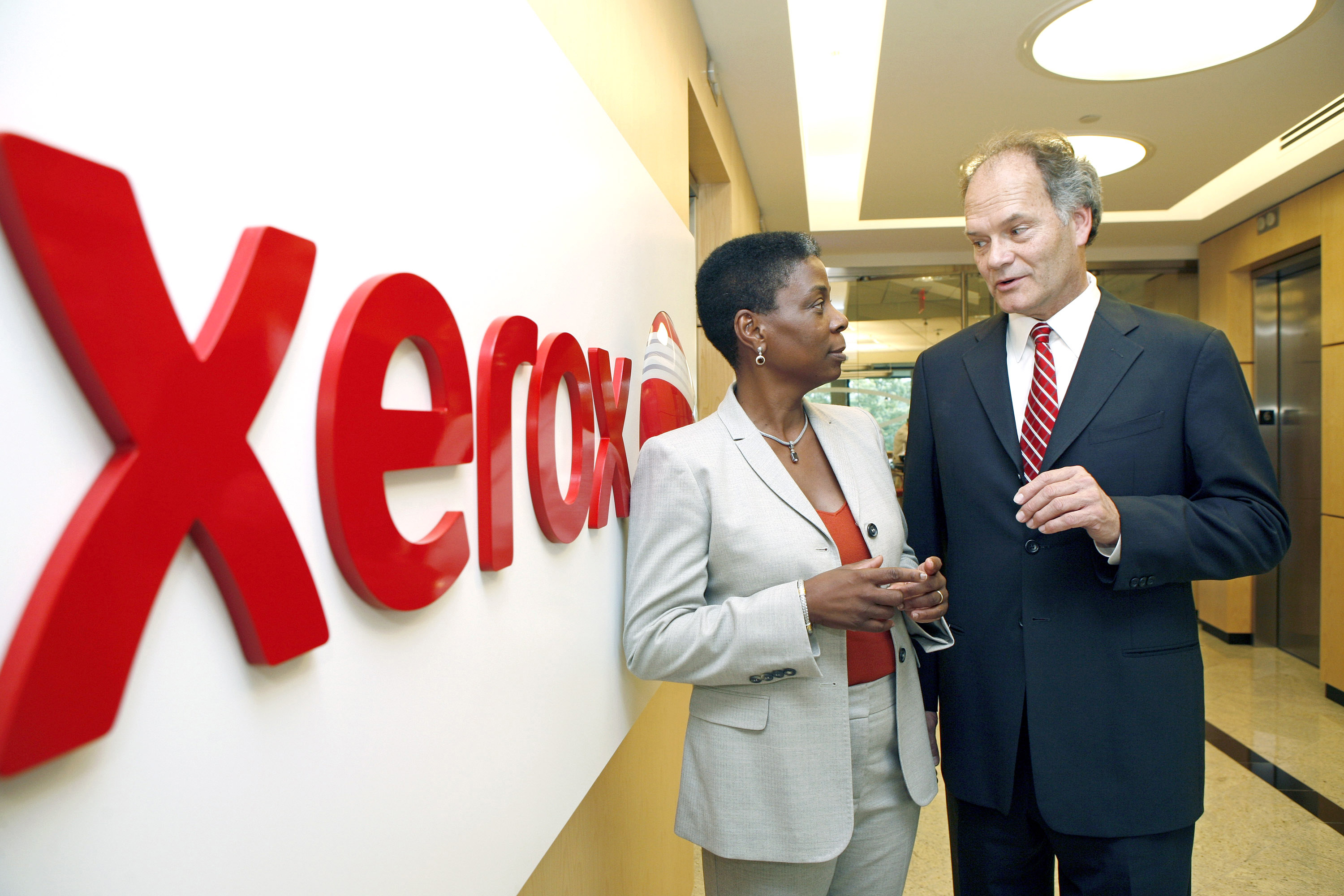
“Burns Succeeds Mulcahy at Xerox in First Big Woman-to-Woman CEO Transition” is the Forbes headline. It’s only too bad that this headline took until 2009 to happen. It’s also too bad that gender issues, such as women CEOs, are worth headlines. But the truth is that the CEO job is still dramatically dominated by men, even though women are half the workforce and been in managerial positions for at least 30 years. Just goes to show it takes a long time for to change old Success Formulas – and its been true that Boards of Directors, and CEOs, tend to replace an outgoing executive with one much like themselves.
“Ursula Burns: An Historic Succession at Xerox” was the Businessweek headline. And not just because the new CEO is a woman. She’s also African American. African Americans have achieved much in the USA, including prominent political positions – such as America’s Presidency. But even though African Americans comprise about 10-15% of the U.S. population, it’s been a very long and arduous climb from the depths of slavery to the CEO suite. Again, old Success Formulas are repeated again and again and again – and for decades that blocked many women and African Americans from achieving the top job in America’s biggest companies.
So kudos to Xerox for building a culture that achieves parity in reviews. They’ve allowed the best and brightest in their organization to rise to the top, unencumbered by old notions about gender and race. And that is a fantastic accomplishment. We should deservedly praise the executives and Board at Xerox for adapting their human resource policies so that promotions are both gender and color blind.
But that doesn’t fix the problem at Xerox. And unfortunately, promoting another insider is likely to be the end of this once great company.
Xerox almost single-handedly killed the small offset lithography business. In the 1960s every major company had several printing presses in the basement. And print shops were everywhere to support the need for duplicate documents. Small offset press manufacturers, and support products like plates, were a huge growth industry. Until Xerox came along with a better technology, and a better pricing scheme. Xerox sold “clicks”, or paper passes through the machine, rather than the machine itself. And this allowed companies to buy far more copiers than they ever imagined. In the 1970s Xerox was THE model sales organization; itself duplicated wherever companies wanted to achieve tremendous growth.
But desktop printing spelled the end of growth for large copiers. Xerox actually had a major impact on the invention of desktop printing, with researchers at Xerox’s Palo Alto Research Center (PARC) creating many of the pieces critical for product viability. But Xerox Locked-in on its copier business, and in the 1980s when the market started shifting Xerox didn’t. By the 1990s, instead of selling millions of small printers, Xerox turned to selling complex copy centers that cost over $100,000 each and took training to operate. While personal printers popped up in offices like popcorn, the large copiers were replaced by smaller and simpler machines on each hall, or went away entirely. Xerox sales started slipping, and by century’s end Xerox was in real danger of disappearing.
The 30 year employee that stopped a complete failure was Ms. Mulcahy. She stopped the cash bleeding, and dealt with the huge debt. Xerox did not go into bankruptcy, but the company saw its revenue drop dramatically and new product launches shriveled up – or were ignored by customers looking for different solutions. Ms. Mulcahy was like the captain on a damaged submarine. She was able to plug the leaks and batten down the hatches so some of the crew survived. But in doing so the submarine kept falling further and further toward the bottom of the ocean. Xerox may be “settled in” on the ocean floor, but how is it supposed to survive? How is it supposed to grow? How is it supposed to accomplish its mission of generating high rates of return year after year?
The market for copiers is not growing, and competition in that marketplace is intense – with machines from Japanese manufacturers such as IBM, Canon and Sharp dominating the market today. Xerox cannot consider its lack of collapse a big win, because in the process it watched the market shift to a raft of new products in both desktop printing and copying where Xerox does not even compete. Competitors have launched machines that are more cost effective to use, and often have better capability. While Xerox was cutting cost, these competitors were gaining share and developing new products. These shifts have left Xerox far removed from competitive viability, even if it is less in debt and cash flow is better.
We commonly see this sort of behavior in companies after a growth stall. They appear on the brink of collapse. But then a smart leader takes dramatic action to stop the bloodletting and “firm up the balance sheet.” The company goes from huge losses to small profits, aided by financial engineering that brings forward costs to pad later P&Ls. Employees and investors breath a sigh of relief, figuring the badness is behind them and everyone can return to the good old days of making money. But these respites are short-lived. Fast enough the company comes face-to-face with customers that demand the new technology and more productive solutions. Rapidly managers realize competitors have made inroads to previously loyal customers, and price erosion is a constant fact of life. In short order, profits again turn to losses and more cutbacks happen as insufficient resources are available for funding new product development and new product launches. What looked for a bit like a big improvement in the business is quickly forgotten as the company falters again.
Americans are an optimistic lot, but there’s nothing in this executive transition that should lead us to be optimistic about the future of Xerox. Ms. Mulcahy was a long-term company veteran who did not change, or even Disrupt, the Xerox Success Formula at all during her tenure. She followed traditional practices of a company in the Swamp, taking draconian actions to delay failure. But she didn’t “fix” the revenue or new product problems. The new CEO is also a 30 year company veteran, and one even less likely to attack the old Success Formula. Where Ms. Mulcahy was from sales, and we might have expected her to undertake a market-focused set of actions, Ms. Burns is from operations and gained her success as someone who looks internally for improvement rather than toward the marketplace.
Again, congratulations to Xerox for being gender and race neutral in selecting its CEOs. But don’t expect a dramatic improvement in the fortunes at Xerox. Xerox is in big, big trouble. It needs to be in new markets it has long ignored, and it needs products the company has long eschewed. The brand has become tainted due to expensive pricing and declining sales. Xerox is so far into the Whirlpool that it is almost infeasible to think of the company becoming “great” again. It would take incredible Disruption and results from very rapid White Space. But Xerox is not skilled in these capabilities, and it doesn’t show the depth of market savvy or product innovation that would be required to make the company a leading competitor. Unfortunately, even though Xerox has successfully changed captains, it is highly unlikely the new CEO will save the ship.
by Adam Hartung | Jul 1, 2009 | Defend & Extend, In the Rapids, In the Swamp, Leadership, Lifecycle
Two sides of a page, two sides of strategy. Two different approaches, two very different sets of results.
That's what struck me when I was waiting for a meeting recently. I picked up a print edition of Businessweek laying in the reception area. On page 13 was "Public Flac Grounds Private Jets." A soft economy has teamed up with bad impressions of executive perks to create a huge drop in orders for private jets. French manufacturer Dassault had 27 more cancellations than orders in the first quarter. U.S. based Cessna had 92 cancellations, and was bracing for 150 more by today (7/1/09). In the meantime, the company has laid off 42% of its workforce and discountinued development of its newest jet aircraft. And the market for used aircraft is flooded, boding poorly for future sales as the used inventory seeks buyers.
Here are two companies that definitely have their "hedgehog concept" as recommended by Jim Collins. They set out to be leaders in private aircraft manufacturing, focusing on two different continents. And they are leaders. They know how to do be product leaders, and they do it well. But look what happened when the market shifted. In dramatic fashion, they go from record profits in 2007 to barely viable. Being really good at making planes doesn't matter when nobody wants them.
Turn the page (literally), and on page 14 was "Now, the Nano Home." In this short article we hear about how Tata Group, which has launched the Nano automobile for under $2,000, is entering the housing development market. While builders in the USA are failing due to the real estate crash, Tata is creating entire apartment developments. But not U.S. style. These apartments sell for as little as $7,800 and come as small as 218 square feet! (There are larger and more expensive units – up to $40,000). While this may seem crazy to Americans, it fits the market where you're trying to convince someone to leave a squatters tenement and buy something legal to live in. It's a market I've never heard of a single American company trying to develop, yet the opportunity is huge!
So here's Tata Group, the company that started as a trading company in the 1860s, that went on to become an industrial powerhouse making chemicals, steel and industrial products. One of, if not the, largest IT services companies on the planet. An auto manufacturer for India that expands into the global market with an entirely new product. Now the company enters homebuildling, but not like other companies. Instead uniquely doing what will fit market needs. There is no hedgehog concept to Tata Group. Just a company that keeps looking for market needs, then develops unique products to fulfill those needs. And builds a 150 year history of growth in the process.
Anytime you have a narrow business, focused on a single market or product line, you are at risk of market shifts that can kill you. These shifts can come from new technologies, or different production processes, or different attributes offered by competitors. But the fact is, markets shift. The better you are at focusing on your hedgehog concept, the more likely it is you will eventually fail. Just look at the companies Mr. Collins claimed were the big winners in Good to Great – Circuit City and Fannie make are good examples. You can be really, really good at something and you end up reaching the pinnacle of expertise only to be clobbered by a market shift that sends you toppling into failure.
Think like Tata Group. Keep your eyes open for market needs. Then figure out new ways to fulfill them. Especially ways that competitors won't attack. Forget about "focus." No American car company is even trying to make a $2,000 car – despite the fact that the only big growth markets today are China, India and other emerging markets where a cheap auto makes the most sense. And all those big U.S. real estate developers that are declaring bankruptcy, after building billion dollar malls, U.S. condominium projects, and office parks aren't even considering building and selling $8,000 apartments to the fastest growing middle class on the globe. They know their hedgehog concept. But they don't know how to grow. You'll do better to focus on growth and leave that hedgehog in his hole.
For more on how following its hedgehog concept led to the bankruptcy of GM download the free ebook "The Fall of GM". Learn how to avoid the hedgehog mistake and keep your business growing.
by Adam Hartung | Jun 30, 2009 | Current Affairs, Defend & Extend, In the Swamp, In the Whirlpool, Leadership, Lock-in, Web/Tech
With all due respect to the great guitar playing songwriter Jerry Reed, today Starbucks and Dell continue to look like copies that were once hot – but now couldn't warm a nose in a blizzard.
"Starbucks continues food push with overhauled menu items" is the Advertising Age headline. Starbucks closed hundreds of stores last year, saw sales in stores open a year fall 8%, and profits dropped 77%. But they aren't bringing anything new to their business. They are revamping the food to make it more healthy. There's nothing wrong with introducing healthier food, but how does Chairman Schultze think this will turn around Starbucks? The company's "return to basics" program has made it overly sensitive to retail coffee prices, while robbing the company of its highly desired cache. An enhanced instant coffee did nothing for revenues. And now this overhauled menu doesn't really offer anything new to excite customers. It's still a ton of calories – even if they are healthy calories – offered at a high price.
Starbucks has given rejuvenated life to McDonald's. Nobody expected the McCafe to be a huge success. But Starbucks has played right into McDonald's sites by shutting down most of its "non coffee" operations and repositioning itself not as a destination but as a fast food outlet. McDonald's reminds me of the hunter who spends all day tramping the forest in search of a deer, only to get back to his pick-up and have a big buck walk within 20 yards of his vehicle. When he least expected to get his kill, it walked up on him. And that's what Starbucks has done. It's made McCafe much more viable than it appeared likely, simply because Starbucks chose to move into direct competition with McDonald's rather than continue on the new business programs it created earlier in the decade.
Starbucks has gifted McDonald's by choosing to fight them head-on right at McDonald's strengths – operational consistency and low price. And now Starbucks is showing complete foolishness by entering into traditional advertising – an area where McDonald's is a powerhouse (the inventor of Ronald McDonald is an expert at ad content and spending). Even worse, Starbucks, which eschewed advertising for years, has decided to promote its new food menu by placing ads in (drumroll please) newspapers! At a time when readership is dropping like a stone, and during summer months when seasonal readership is lowest, Starbucks is choosing to promote with the least effective ad medium available today. Even billboards would be a better choice! We have to ask, wouldn't the previous, much savvier, leadership have launched a wickedly intensive web marketing program to lure customers back into the stores? Some viral videos, lots of social media chat – that sort of thing which appeals to their target buyer? Why would anyone choose to fight a giant – like McD's – on their court, using their rules, against their resource strength? That's not savvy competition, it's suicide.
Simultaneously the once high-flying Dell has been in the doldrums for several years. Decades ago Dell built a Success Formula that ignored product developed, placing its energy into supply chain advantages. Competitors have matched those operational advances, and now Dell gives consumers little reason to make you prefer their product. Not to mention forays into service cost reductions like offshore customer support that absolutely turned off customers and sent them back into retail stores.
Now "Dell is working on a pocket web gadget" according to the Wall Street Journal headline. Not a phone, not a netbook, not a laptop the new device is an assemblage of acquired technology into a handheld internet device. How it will be used, and why, is completely unclear. That it will give you internet access seems to be the big selling point – but when you can accomplish that with your iPhone or Pre, or netbook should you choose a larger format, why would anyone want this device?
Dell seems to forget that it has to compete if it wants to succeed. It's products have to offer customers something new, something better. That's what made the iPHone so successful – it gave users a lot more than a traditional phone. And the same is true for Pre. And these devices now have dozens and dozens of applications available – everything from playing video games to ordering pizza at the closest delivery joint to reading MRI screens (if you happen to be a neurologist). Yet, this new Dell device has no new apps, and it's unclear it is in any way superior to your phone or netbook. Dell keeps trying to think it has distribution superiority, and thus can sell anything by forcing it upon customers. Even products that have no clear application. Dell is Locked-in to its old Success Formula, all about operational excellence, but that model has no advantage now that people with new technology – superior technology – can match their operational excellence.
When companies remain Locked-in too long they become obsolete. And it can happen surprisingly fast. Every reader of this blog can remember when Starbucks seemed invincible. And when Dell was the information technology darling. But both companies remain stuck trying to Defend & Extend their Success Formulas after the market has shifted – and their results are most likely going to end up similar to GM.
Don't forget to download my new ebook "The Fall of GM" and send it (or the link) along to your friends and social network pals. http://tinyurl.com/nap8w8